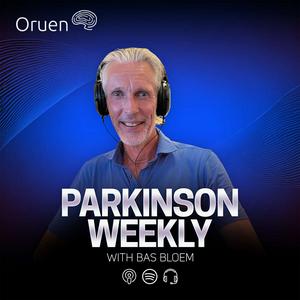
Parkinson Weekly

Oruen CNS
Parkinson Weekly
Senaste avsnittet

26 avsnitt

  • Parkinson Weekly

    EP 22 - Article Of The Week: Dual-Risk axis: GBA1 mutations and occupational pesticide exposure in Parkinson's Disease

    2026-02-26 | 18 min.
    🎙️ We’re back with the twenty second episode of Parkinson Weekly, hosted by Prof. Bas Bloem.
    In this episode, Bas explores the role of gene–environment interactions in Parkinson’s disease, examining why some individuals develop Parkinson’s following environmental exposure while others do not.
    Discussing a recent study published in the Journal of Parkinson’s Disease, he reviews new evidence linking GBA1 genetic mutations with occupational pesticide exposure, highlighting how genetic susceptibility may influence vulnerability to environmental risk factors.
    Bas explains the biological mechanisms behind this interaction, including impaired cellular waste clearance and mitochondrial dysfunction, and reflects on the broader implications for research, prevention strategies, and regulatory policy. The key message: Parkinson’s risk may be shaped not by genes or environment alone, but by the interaction between the two.
    An important episode that advances our understanding of Parkinson’s disease risk and underscores the need to consider genetic vulnerability in environmental health and future research.
    👉 You can read the full article here: https://pubmed.ncbi.nlm.nih.gov/41549707/
    Have a question you’d like Bas to answer in a future episode? Email us at [email protected] – we’d love to hear from you.

  • Parkinson Weekly

    EP 21 - Article Of The Week: Hearing Loss in Parkinson's Disease: A Systematic Review and Meta-Analysis

    2026-02-19 | 12 min.
    🎙️ We’re back with the twenty first episode of Parkinson Weekly, hosted by Prof. Bas Bloem.
    In this episode, Bas explores a surprising and often overlooked question: is hearing loss part of the Parkinson’s disease phenotype?
    Discussing a 2026 systematic review and meta-analysis published in Movement Disorders, he highlights compelling evidence that hearing impairment is common in Parkinson’s — affecting nearly 80% of patients across pooled studies. High-frequency hearing loss was particularly prevalent, and abnormalities in central auditory processing suggest this is not simply age-related decline, but potentially linked to Parkinson’s-specific brain changes.
    Bas reflects on why this matters clinically, including the association between hearing loss, cognitive decline, and social isolation. The key message: hearing impairment is common, under-recognised, and should not be dismissed as “just ageing.”
    An important episode that broadens our understanding of the non-motor and sensory features of Parkinson’s disease.
    👉 You can read the full article here: https://pubmed.ncbi.nlm.nih.gov/41618507/
    And don't forget, you can listen here:
    Have a question you’d like Bas to answer in a future episode? Email us at [email protected] – we’d love to hear from you.
  • Parkinson Weekly

    EP 20 - Article Of The Week: Exploring the impact of Parkinson's disease on driving: a population-based survey

    2026-02-12 | 12 min.
    🎙️ We’re back with the twentieth episode of Parkinson Weekly, hosted by Prof. Bas Bloem.
    In this episode, Bas discusses Exploring the impact of Parkinson’s disease on driving: a population-based survey, a large real-world study examining how Parkinson’s affects driving ability, licence retention, and conversations between patients and healthcare professionals.
    Driving is closely tied to independence, identity, and quality of life — yet both motor and non-motor symptoms of Parkinson’s can compromise safety behind the wheel. Bas walks listeners through the findings of this population-based survey, which showed that most people with Parkinson’s still hold a valid driving licence, often many years after diagnosis, with many voluntarily adapting their driving habits by reducing distances or avoiding night-time travel. However, fewer than half had discussed driving with a healthcare professional, highlighting an important and often overlooked gap in routine care.
    He explores the broader factors that influence safe driving, including cognitive slowing, executive dysfunction, visual–spatial challenges, and the ability to respond under pressure — issues that may not always be captured during standard clinic assessments. Bas also considers the limitations of self-reported confidence and discusses the potential role of structured or simulator-based testing.
    This episode provides practical, real-world guidance for clinicians, patients, and families, emphasising the importance of regular conversations, early identification of risks, and supportive strategies to help people with Parkinson’s maintain safe mobility and independence for as long as possible.
    👉 You can read the full article here: https://pubmed.ncbi.nlm.nih.gov/39545559/
    Have a question you’d like Bas to answer in a future episode? Email us at [email protected] – we’d love to hear from you.
  • Parkinson Weekly

    EP 19 - Parkinson’s disease: cognitive challenges and the practical “detours” people use to navigate them in daily life

    2026-02-05 | 15 min.
    🎙️ We’re back with the nineteenth episode of Parkinson Weekly, hosted by Prof. Bas Bloem.
    In this episode, Bas shines a light on an often overlooked aspect of Parkinson’s disease: cognitive challenges and the practical “detours” people use to navigate them in daily life. He pays tribute to the late Marina Noordegraaf — artist, advocate, and person with Parkinson’s — whose pioneering work helped make these invisible thinking obstacles visible.
    Building on her earlier work around motor “detours” for freezing of gait, Bas explores Marina’s beautifully illustrated book Detours through the Parkinsonian Brain, which focuses on strategies to compensate for cognitive difficulties such as slowed thinking, attention problems, planning challenges, memory lapses, and executive dysfunction. Drawing on interviews with more than 450 people with Parkinson’s and over 130 care partners, the project captures real-world solutions developed by patients themselves.
    Bas discusses the concept of functional cognition — how cognitive skills translate into everyday performance — and why challenges often emerge not in clinic-based tests but in complex, stressful, real-life situations. He highlights the practical tools outlined in the book, including environmental adjustments, behavioural strategies, and simple communication techniques to help patients and families manage thinking obstacles more effectively.
    This episode offers a thoughtful and highly practical perspective for clinicians, patients, and caregivers alike, emphasising that while cognitive symptoms may not always be visible, they are common, impactful, and often manageable with the right strategies.
    Have a question you’d like Bas to answer in a future episode? Email us at [email protected] – we’d love to hear from you.
  • Parkinson Weekly

    EP 18 - Article Of The Week: Effect on Dyskinesia of the Early Combination of Amantadine to Levodopa-Therapy in Parkinson's Disease: A Randomized, Placebo-Controlled Study (PREMANDYSK)

    2026-01-29 | 18 min.
    🎙️ We’re back with the eighteenth episode of Parkinson Weekly, hosted by Prof. Bas Bloem.
    In this episode, Bas discusses new evidence on an old drug: amantadine. He reviews the PREMANDYSK study, a large multicentre, randomised, placebo-controlled trial conducted across 15 specialist centres in France and published in Movement Disorders, which investigated whether early use of amantadine can delay or prevent the development of levodopa-induced dyskinesias in people with Parkinson’s disease.
    Bas walks listeners through the study’s innovative delayed-start and washout design, explains why amantadine’s unique dopaminergic and NMDA-antagonist properties make it biologically plausible for this role, and highlights the key findings — including a 50% reduction in peak-dose dyskinesias at 18 months, lower levodopa dose escalation, and modest benefits for freezing of gait, fatigue, and quality of life, without an increase in adverse events.
    He also offers a balanced interpretation of what the results do — and do not — tell us about true disease modification, discusses important limitations such as follow-up duration and patient selection, and reflects on how these findings may influence clinical decision-making today. Bas closes by reappraising amantadine’s place in Parkinson’s care, particularly as an underrated, cost-effective option for the right patient, while emphasising the need for further long-term research.
    👉 You can read the full article here:
    https://pubmed.ncbi.nlm.nih.gov/41316871/
    Have a question you’d like Bas to answer in a future episode? Email us at [email protected] – we’d love to hear from you.

Fler podcasts i Hälsa och motion

Om Parkinson Weekly

Parkinson Weekly is your go-to podcast for the latest insights in Parkinson’s disease. Each week, Professor Bas Bloem, Consultant Neurologist in the Department of Neurology at Radboud University Medical Center, Nijmegen, takes you through his chosen “Article of the Week” – highlighting new research, clinical perspectives, and what it means for patients, carers, and healthcare professionals.Have a question you’d like Bas to answer on the podcast? Email us at [email protected] – we’d love to hear from you.Stay informed, stay connected, and join us every week for clear, expert-led discussions on Parkinson’s.
Podcast-webbplats

Lyssna på Parkinson Weekly, Nyfiken På och många andra poddar från världens alla hörn med radio.se-appen

Hämta den kostnadsfria radio.se-appen

  • Bokmärk stationer och podcasts
  • Strömma via Wi-Fi eller Bluetooth
  • Stödjer Carplay & Android Auto
  • Många andra appfunktioner

Parkinson Weekly: Poddsändningar i Familj

Sociala nätverk
v8.7.2 | © 2007-2026 radio.de GmbH
Generated: 3/4/2026 - 9:44:21 AM