PoddsändningarNäringslivAggressively Human: Online Business in the Age of AI, Algorithms & Automations

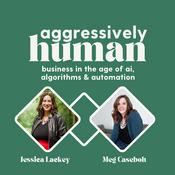
Aggressively Human: Online Business in the Age of AI, Algorithms & Automations

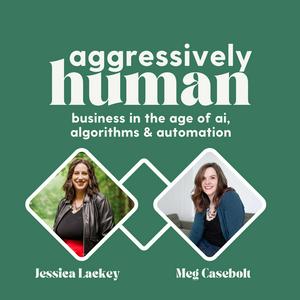
Meg Casebolt & Jessica Lackey
Aggressively Human: Online Business in the Age of AI, Algorithms & Automations
Senaste avsnittet

65 avsnitt

  • Aggressively Human: Online Business in the Age of AI, Algorithms & Automations

    Is it burnout or boredom?

    2026-02-26 | 55 min.
    Every business owner hits that point where the thing that used to light them up now feels like a slog — and it usually happens right when the work matters most. Whether it’s February fatigue, launch number seven, or the creeping suspicion that you’ve said everything you have to say, the impulse to burn it down and start fresh is real. But is it burnout, boredom, or just a season?
    In this episode, we talk about the difference between being tired of something in your business and being done with it. We dig into the natural cycles of building — preparing, planting, harvesting, and resting — and why the reinforcement phase (the one that actually creates momentum) is the hardest to stay motivated through. Jessica shares what it’s like to be in the “hardening the cement” stage while wanting to chase something new, and Meg talks about her experience running Social Slowdown for 100 episodes and knowing when it was time to hand off the torch.
    This isn’t a pep talk about pushing through or a permission slip to quit. It’s a conversation about learning to read the signals your energy is sending you.
    * Why the repetition phase of your business feels boring but is where the real traction happens
    * The seasonal cycles of energy and creativity (and why Meg doesn’t launch anything in February)
    * Jessica’s harvest-to-reinforcement arc — and the tension between solidifying old work and chasing new ideas
    * The green light / yellow light / red light framework for deciding when to push, pause, or stop
    * Why your audience hears your message differently every time, even when you’re saying the same thing
    * How Meg knew it was time to retire Social Slowdown after 100 episodes and a book
    * The difference between reinforcing, repurposing, remixing, and just regurgitating your content
    * What to do when you still need to market but have nothing new to say
    * Why your best referral partners being in the same slump at the same time is a real business risk
    How relationships and referral networks carry your message when you can’t
    "Reinforcing is going back in and putting more infrastructure in place to make it stronger. Repurposing is, or rehashing for that example is taking the same information and pushing it out in a different place. Remixing could be finding new ways to explain something." — Meg

    Mentioned
    Amelia Hruby/Off the Grid
    Connect with Us
    Listen on Spotify
    Listen on Apple Podcasts
    Meg Casebolt
    Jessica Lackey


    This is a public episode. If you would like to discuss this with other subscribers or get access to bonus episodes, visit aggressivelyhuman.substack.com

  • Aggressively Human: Online Business in the Age of AI, Algorithms & Automations

    Are we recording a podcast or a leading a movement?

    2026-02-19 | 37 min.
    Most podcasts don’t make it past episode 10. But somewhere around the year mark, something shifts—what started as exploring ideas and meeting people can quietly become something bigger, with more weight and more responsibility than you signed up for.
    In this episode, we explore the difference between hosting a podcast and leading a movement. We talk about the three types of motivations for a platform: the desire for fame, the intentional choice to lead with a platform, and the moral imperative—when you have something to say that no one else is saying.
    This is a conversation about the reluctant responsibility that comes with showing up consistently, having strong points of view that shapes the discourse, and being willing to change your mind as you learn more.
    * The three motivations for creating a platform: fame, leadership with a platform, and moral imperative
    * What we can learn from Hamilton and Burr, especially why “I want to be in the room where it happens” is different from creating the authority to create the room.
    * Creating into the void—the lag time between creating content and seeing its impact
    * What changes when people start quoting your work back to you
    * Why reluctance to lead (because you want to get it right) is an act of integrity
    * The responsibility of being a standard bearer when people you looked up to aren’t active in the space anymore
    * How compounding authority works over time
    * The difference between selling services directly vs. articulating a point of view
    * Why having strong points of view while staying open to changing your mind is so hard
    “I think that when you’re a movement leader, you have to be willing to walk on the ledge more publicly for much longer. With less feedback than you anticipate.” - Jessica
    Resources Mentioned
    Antimemetics
    Connect with Us
    Listen on Spotify
    Listen on Apple Podcasts
    Meg Casebolt
    Jessica Lackey


    This is a public episode. If you would like to discuss this with other subscribers or get access to bonus episodes, visit aggressivelyhuman.substack.com
  • Aggressively Human: Online Business in the Age of AI, Algorithms & Automations

    The State of Social Media in 2026 with Andréa Jones

    2026-02-12 | 54 min.
    Social media in 2026 is definitely not the same as before 2020—and not even the same as it was last year. And for our “Aggressively Human” take on how social fits in your marketing stack, we’re bringing on our favorite Mindful Marketing mentor and return guest Andréa Jones.
    In this episode, we’re talking about what’s actually happening on social platforms in 2026, especially for expertise-led businesses that don’t want to become full-time media companies.
    We talk about the TikTok effect, discovery-driven algorithms, and why entertainment now beats education on most feeds. Andréa shares how she thinks about social media today, how she uses it in her own business, and where it fits alongside other channels like podcasts, newsletters, websites, and SEO. We also talk about why viral content often fails to translate into clients, and how people really decide who to hire.
    This episode is an honest discussion at where social media sits now in a broader marketing mix—and what expectations make sense to have if you’re still showing up there.
    * Why social media feels louder, faster, and less useful than it used to
    * The “TikTok effect” and how it changed every platform
    * Discovery algorithms vs. follower-based feeds
    * Why entertainment content outperforms educational content
    * How engagement has declined across most platforms (and what that means)
    * Why viral posts often don’t translate into revenue
    * What Andrea puts in place before social media matters
    * The role of podcasts, newsletters, websites, and SEO
    * Local vs. national businesses and how discovery actually works
    * Why repetition builds trust (for humans and AI)
    “It takes a lot more effort for someone to leave that video or leave that post and go somewhere else to then do something else, like sign up for a newsletter or purchase something. So that sales cycle has gotten astronomically longer.
    And so I'm not saying social media isn't important. Especially for me, it's a great networking tool. However, it's not, and as far as the hierarchy goes, it's just not as important as other marketing assets. And so I had to shift the way that I think about that.” -Andréa

    About our Guest
    Website
    OnlineDrea on Instagram
    Mindful Marketing Podcast
    Connect with Us
    Listen on Spotify
    Listen on Apple Podcasts
    Meg Casebolt
    Jessica Lackey


    This is a public episode. If you would like to discuss this with other subscribers or get access to bonus episodes, visit aggressivelyhuman.substack.com
  • Aggressively Human: Online Business in the Age of AI, Algorithms & Automations

    Has the "online course bubble" popped?

    2026-02-05 | 50 min.
    Lately, a lot of well-known course creators have closed their flagship programs or shut down their podcasts. Other online course creators who will “never again sell live training”…. well, they’re back with live training.
    Is the course bubble over? Will AI shut down courses? Or is this just an industry hot take to get clicks and views?
    In this episode, we talk about what’s actually happening with courses right now—and what’s not. We look at why self-guided, evergreen courses worked for so long, why they’re struggling to convert and retain attention now, and how AI has sped up changes that were already underway. We talk about how this has shown up in the various evolutions of our own businesses. We also talk about where courses still make sense, where they don’t, and why people are increasingly unwilling to pay for information without context, support, or application. (A multimedia interactive experience as Jessica called it in corporate-speak).
    This isn’t a declaration that courses are dead. It’s a conversation about saturation, economics, attention, and what people actually want help with in 2026.
    * Why course closures are becoming more common
    * The difference between a bubble bursting and a market maturing
    * What made evergreen courses work in the first place
    * How rising ad costs and shrinking arbitrage changed the math
    * Why beginner-level education scaled—and why it hit a ceiling
    * What AI replaced almost instantly (templates, boilerplate, generic content)
    * How Meg and Jessica have both surfed the wave of courses, both as leaders and as students
    * What people still pay for (and what they won’t)
    * The problem with “lifetime access” promises
    * Courses as one piece of a broader ecosystem, not the whole business
    “If you have a giant course where you promise to do everything, then you can’t do all of it well. And I think people are getting a little bit tired of like the survey courses, like the freshman 101 course of everything, or maybe those still exist. And I’m just out of the world view where I’m paying attention to them. But anytime that you have an all in one solution, whether that’s a course or a piece of software, or a coach who says that they can help you with everything, that breadth is going to prevent depth.
    And if you want to learn something deeply from a person who understands it and can answer your questions when things go wrong, then that’s when you want to find an expert who teaches one thing really well instead of 10 things mediocre.” - Meg

    Connect with Us
    Listen on Spotify
    Listen on Apple Podcasts
    Meg Casebolt
    Jessica Lackey


    This is a public episode. If you would like to discuss this with other subscribers or get access to bonus episodes, visit aggressivelyhuman.substack.com
  • Aggressively Human: Online Business in the Age of AI, Algorithms & Automations

    The stories that get shared: Community-Forward Media with Lex Roman

    2026-01-29 | 51 min.
    In this episode, we talk with Lex Roman, founder of Revenue Rulebreaker, about why solopreneurs and micro-business owners are almost invisible in mainstream business media—and what happens when someone actually builds a platform for them. Lex shares how Revenue Rulebreaker grew out of a personal experiment in becoming a full-time creator and turned into an independent media publication focused on indie businesses, real revenue experiments, and work that doesn’t fit the venture-scale mold.
    We spend a lot of time on what’s broken in business media: pay-to-play outlets, thought leadership that’s really just a sales funnel, and the absence of honest stories about what it’s like to run a small, durable business. Lex explains why journalists aren’t filling that gap, why solo businesses have a hard time surfacing interesting angles, and why so much valuable knowledge stays trapped in private conversations instead of becoming public learning.
    The conversation also gets practical. We talk about subscriptions versus memberships, why Revenue Rulebreaker is a media brand and what does that mean, and how sponsorships, subscriptions, and community-adjacent networks can coexist with (or sit alongside) client work. Underneath it all is a bigger question: what would business culture look like if we treated podcasts, newsletters, and blogs as media—not just marketing?
    * How Revenue Rulebreaker started as a personal experiment and became an indie media publication
    * Why solopreneurs and micro-business owners are ignored by mainstream business media
    * The collapse of traditional journalism and what it means for business coverage
    * Why pay-to-play outlets distort whose voices get amplified
    * Why having an “angle” is how stories get platformed
    * The difference between thought leadership, marketing content, and media
    * The problem with content that always has to sell something
    * Subscriptions vs. memberships—and why Lex is intentionally avoiding a membership model
    * How sponsorships and subscriptions actually fund indie media
    * Why private experiments inside small businesses are some of the most valuable stories we never see
    * The role of community, networks, and stewarded spaces in a post-algorithm internet
    “Journalists previously who would have been sourcing those stories don’t know a lot of business owners, but they know the woman who started Spanx.
    So they’re just not that working that hard to find stories. So if they don’t know any business owners, and you don’t pitch them a compelling story, that story’s not getting told. I think also business owners have a really hard time understanding what’s cool and interesting about their own business.
    Like, you know, they’re like, “I’d like to have my business platformed.” Of course you would, but you don’t have an angle? What’s your perspective? Why are you doing this interesting thing? You have to really dig at them to find those interesting things.” - Lex Roman

    About our Guest
    Revenue Rulebreaker
    Become a Legend
    Lex Roman on LinkedIn
    Mentioned Resources
    Cal Newport - Can Substack Save Journalism?
    Antimemetics
    Connect with Us
    Listen on Spotify
    Listen on Apple Podcasts
    Meg Casebolt
    Jessica Lackey


    This is a public episode. If you would like to discuss this with other subscribers or get access to bonus episodes, visit aggressivelyhuman.substack.com

Fler podcasts i Näringsliv

Om Aggressively Human: Online Business in the Age of AI, Algorithms & Automations

In a world focused on more: more content, more followers, more marketing, more scale, more noise… we’re facing less trust, less contact, less reach. We’re drowning in AI-generated slop, being pitch-slapped by “personalized” email funnels that couldn’t be farther from authentic, and struggling to be seen by a pay-to-play algorithm. It’s never been easier to create and connect more cheaply and at more scale, with less trust and more skepticism. But for experts and service-based businesses? We’re seeing the pendulum swing back. The answer isn’t to play by these trends. It’s to be **aggressively human.** aggressivelyhuman.substack.com

Podcast-webbplats

Lyssna på Aggressively Human: Online Business in the Age of AI, Algorithms & Automations, Fill or Kill och många andra poddar från världens alla hörn med radio.se-appen

Hämta den kostnadsfria radio.se-appen

  • Bokmärk stationer och podcasts
  • Strömma via Wi-Fi eller Bluetooth
  • Stödjer Carplay & Android Auto
  • Många andra appfunktioner
Sociala nätverk
v8.7.0 | © 2007-2026 radio.de GmbH
Generated: 2/27/2026 - 2:04:49 AM