
Lyssna på den här podden kostnadsfritt i appen: Ladda ner gratis i App Store
radio.se
Sleeptimer
Spara kanal
7 avsnitt
LCP#7: Studies the Six Small Pyramids at Giza. Matt LaCroix Did.
2026-10-20 | 1 hOn the Giza Plateau, inside the Sphinx Temple, an area closed to visitors, Matt LaCroix found the three level step pyramid design he has followed across Peru, Bolivia and Türkiye embedded in a stone, with the same geometry repeated across the excavated layouts of the Sphinx and Valley temples. That discovery led him to three small structures beside the Pyramid of Menkaure, catalogued as G3-a, G3-b and G3-c and known as the Queens’ tombs. Drawing on the work of George Reisner and Mark Lehner, Matt notes that Reisner found no original burials and considered G3-c a functional pyramid, with a wide top composite step pyramid at its entrance. In Matt’s reading, the three structures move from three levels to four and then to a smooth finish, a sequence he also traces in the eroded Khufu triad beside the Great Pyramid and in the threshold of its Queen’s Chamber.
From there Matt sets out what he calls a 3 to 4 completion model, first identified in the Lake Van region, and proposes that the Giza Plateau encodes a wave that rises to completion and then begins again, mirroring the Hermetic law of rhythm. In his interpretation, the ages of humanity follow this same rhythm, and the civilization remembered as Atlantis mapped these waves closely enough to see its own reset coming. He also reclaims the unfinished pyramid and its eye as an ancient symbol of completion and the mind’s eye. These ideas build on his book The Missing Key: Ancient Code of a Lost Civilization, and Matt closes with his view that humanity is now entering a period of completion, ahead of an upcoming expedition to the Giza Plateau with Robert Grant.
CHAPTERS
00:00 Trailer
00:59 Welcome to episode 7
05:09 A baseline for new viewers
07:00 Two kinds of three level step pyramid
08:12 The composite pyramid and the Kef relief
10:10 Three symbols to follow at Giza
11:11 A discovery inside the Sphinx Temple
12:32 T shapes in the Sphinx and Valley temples
13:56 An upcoming expedition to Egypt
14:37 The overlooked structures below Menkaure
17:16 George Reisner and Mark Lehner
19:47 G3-a, G3-b and G3-c
21:52 Reisner’s case against the Queens’ tombs
24:59 From three levels to completion
25:35 Tesla and the numbers 3, 6 and 9
27:03 The 3 to 4 completion model
29:04 The Great Pyramid as a scale model of Earth
30:01 Three doors around the world
30:57 Symbols in the mortuary temples
32:26 The gateway threshold inside the Great Pyramid
33:21 The Queen’s Chamber motif
34:17 The Khufu triad and the Temple of Isis
37:00 Giza as a wave model
39:47 The Hermetic law of rhythm
42:29 Atlantis and the cycle of ages
44:35 The unfinished pyramid and the eye
46:08 The mind’s eye
47:59 The Founding Fathers and the dollar bill
48:49 The cosmogram and the number three
50:05 The T as a symbol of balance
51:16 Three flowers of the Lake Van region
53:36 Human consciousness completes the circuit
55:54 Entering an age of completion
59:46 Closing thoughts
MATTHEW LACROIX
https://thestageoftime.com
BOOKS
https://thestageoftime.com/books
THE ANCIENT CODE DATABASE
https://thestageoftime.com/acd-i
THE LOST CIVILIZATIONS PODCAST
https://thestageoftime.com/podcastThe Pharaohs Didn't Build Giza. The Pharaohs Moved Into Giza
2026-10-16 | 2 h 35 min.In 1837, Howard Vyse broke into the sealed chambers above the King's Chamber of the Great Pyramid and found a workers' cartouche naming Khufu, the find that still anchors the claim that Khufu built it. In episode six of the Lost Civilizations Podcast, Matt sits down with Egyptologist Mohamed Ibrahim to lay out the conventional dynastic timeline and then test it against the evidence on the ground. Mohamed argues that Khufu left no record claiming the pyramid and that the name itself may be a title, while Matt turns to Manly P. Hall's reading of Herodotus and the tomb story. From there they work through the scans that showed a void beneath the Sphinx's right paw, the water erosion on the Sphinx enclosure, machine-like tool marks on basalt and predynastic stone vases, the granite boxes of the Serapeum, the unfinished obelisks at Aswan and the shrine on Elephantine Island.The dating in this conversation is Matt's and Mohamed's own reading. Drawing on Robert Schoch's geology and the Sphinx's alignment with Leo, Matt places the Sphinx at roughly 12,000 years old at minimum and favors John Anthony West's date of around 38,000 years, while Mohamed ties the Sphinx and the Sphinx Temple to the last rainy period before 9700 BC. Matt also shares how a photo he bought at a yard sale eight years ago led him to the step pyramid and T forms he reads in the Sphinx Temple layout, which he sees as the key to the ancient code at the heart of The Missing Key, before closing on the seven Hermetic principles and what the ancient Egyptians recorded about the stars.
Mohamed Ibrahim is an Egyptologist and tour guide who grew up near Saqqara and has spent his career studying ancient Egypt on site. He has worked in the field alongside Robert Schoch, joined one of the first private visits to the Sphinx Temple.MATTHEW LACROIXhttps://thestageoftime.comBOOKShttps://thestageoftime.com/booksTHE ANCIENT CODE DATABASEhttps://thestageoftime.com/acd-iTHE LOST CIVILIZATIONS PODCASThttps://thestageoftime.com/podcastOne Symbol Connects Bolivia, Turkey, India and Egypt
2026-10-07 | 2 h 1 min.Explore the symbols from this episode in The Ancient Code Database: https://thestageoftime.com/acd-iAt the Aswan quarry in Egypt, Derek Olson once pounded red granite with a dolerite stone for a full minute and barely left a scratch. That experience sets the tone for this conversation at Puma Punku and Tiwanaku, the sister sites on the southeast side of Lake Titicaca in Bolivia, where Matt LaCroix and Derek examine precision cut gray andesite, H blocks with no visible tool marks and drill holes so small they defy Iron Age tools. Mainstream archaeology credits the Tiwanaku culture with the work around 1,400 years ago. Matt instead follows Arthur Posnansky, who dated the sites to around 17,000 years ago from their celestial alignments, and in Matt's reading this is a Pleistocene site that later cultures inherited and tried to imitate.The second half turns to the symbol Matt sees repeated across the stonework, a three level inverted step pyramid set above a doorway. In his interpretation it represents a metaphysical realm, and paired with the doorway it marks a gateway between realms, a reading he extends to the Gate of the Sun, the figure of Viracocha, the layout of the Akapana pyramid and the Kailasa Temple in India, with parallels in the Lake Van region explored in his book The Missing Key: Ancient Code of a Lost Civilization. Derek adds the Andean cosmology of the three worlds, and Matt closes with his view that if this was a technology, it could one day be reactivated.CHAPTERS00:00 Trailer01:45 Welcome Derek Olson04:27 How Derek discovered megalithic stonework07:39 Puma Punku and Tiwanaku at Lake Titicaca13:15 Why so much is still unexcavated14:36 Andesite cuts and the Lake Van comparison17:56 Pedro Cieza de León's first account20:13 Arthur Posnansky and the 17,000 year date27:47 Two masonry types at Tiwanaku32:05 Iron Age tools against hard stone34:45 Missing tool marks and the geopolymer question43:28 Moving blocks of up to 500 tons48:18 Micro drill holes and machine cuts50:08 Pounding granite at Aswan54:05 Where did the technology go55:08 The inverted step pyramid at the Moon Gate57:43 The Chakana and a relief from Lake Van1:01:55 Heaven, hell and the underworld1:06:27 The composite step pyramid at Ollantaytambo1:08:04 Water that stops at a touch1:11:22 The fallen gate at Tiwanaku1:13:15 The gateway symbol1:18:40 The 3 to 4 completion model1:21:29 Da Vinci's Last Supper and the middle door1:27:31 What Viracocha is standing on1:29:34 The Akapana layout1:31:27 Kailasa Temple in India1:35:54 Derek's find at the Tiwanaku museum1:37:57 Haldi and the middle door1:42:17 The three worlds of Andean cosmology1:44:52 Why academia has missed this1:51:36 Reconnecting with natural cycles1:56:22 Giza and the middle star of Orion's Belt1:59:53 Closing thoughtsGUESTDerek Olson is the founder of Megalithic Marvels, which he launched in 2017 after a trip to Peru convinced him that a lost civilization shaped its megalithic walls. His interest began in 2012 with a single photo of polygonal precision stonework, and he has since visited ancient sites across Peru, Bolivia, Egypt and Easter Island, sharing a vast library of megalithic images with his audience.Check Derek's Channel out here: @MegalithicMarvels Website: https://megalithicmarvels.com/Tours: https://megalithicmarvels.com/tours/MATTHEW LACROIXhttps://thestageoftime.comBOOKShttps://thestageoftime.com/booksTHE ANCIENT CODE DATABASEhttps://thestageoftime.com/acd-iTHE LOST CIVILIZATIONS PODCASThttps://thestageoftime.com/podcastThe Inca Said They Didn't Build Sacsayhuamán. So Who Did?
2026-09-30 | 1 h 24 min.When the Spanish reached Cusco, they climbed the hill above the city to Sacsayhuaman and found walls built from stones of up to 125 tons, quarried about three miles away across hills and valleys. They asked the Inca whether they had built them, and the Inca told them the walls were already standing when they arrived.Brien Foerster heard a different answer on his first day in Peru, twenty years ago. Standing on a side street in Cusco in front of a wall so tightly fitted that paper will not slide into the joints, he asked his guide who made it and was told the Inca had, with bronze chisels. He has been visiting the sites that prompted that question ever since.In the fourth episode of the Lost Civilizations Podcast, Matthew LaCroix sits down with the researcher he credits with opening the field to him, and the two walk the Andes site by site through Sacsayhuaman, Ollantaytambo, Ñaupa Huaca, the Qorikancha and Machu Picchu. At every one they find a megalithic core of hard, precisely fitted stone with cruder Inca work and clay mortar built over it or patched into it. The granite at Ollantaytambo came from a quarry at the summit of the mountain, while the rock at Ñaupa Huaca is harder than granite and carries no tool marks. Brien explains why a bronze chisel bends on its first strike against stone like this, and neither man has heard a plausible account of how Bronze Age tools could have done the work.Their own explanation is that an acoustic or vibrational technology softened and lifted the stone, and they present it plainly as their reading of the evidence. Along the way Brien covers the false doorway at Amaru Muru and the elongated Paracas skulls he believes were born that shape.Matt then turns to a symbol he has tracked across several continents, a three-level step pyramid with a wide flat top that he calls the composite step pyramid. It appears at Ñaupa Huaca and Machu Picchu, beneath Viracocha on the Gate of the Sun at Tiwanaku, and on a relief from the Van region of eastern Turkey, where reversing one sequence of carvings produces the same form. He reads it as part of the grammar of an ancient knowledge system.The two disagree about how those builders were connected. Brien thinks several advanced civilizations rose and fell at different times, perhaps unaware of each other, whereas Matt argues they were linked nodes of a single mother civilization, and he makes that case before the close.GUESTBrien Foerster has spent about twenty years exploring megalithic sites full time. He lives in Peru and has visited Machu Picchu more than a hundred times, Egypt more than ten times and the sites of Bolivia dozens of times. He has published 37 books and more than 4,500 videos.Find out more from Brien here: https://hiddenincatours.com/MATTHEW LACROIXhttps://thestageoftime.comBOOKShttps://thestageoftime.com/booksTHE ANCIENT CODE DATABASEhttps://thestageoftime.com/acd-iTHE LOST CIVILIZATIONS PODCASThttps://thestageoftime.com/podcastI Found the Lost Ararat Civilization at the Bottom of Lake Van | LCP #3
2026-09-25 | 2 h 20 min.In 2017, underwater photographer Tahsin Ceylan was diving off the north shore of Lake Van in eastern Turkey to film carbonate mounds when he came across stone walls on the lake floor. The press reported a 3,000 year old Urartian castle, and the story went quiet.Matthew LaCroix has spent three years working in the Van region with geologist Robert Schoch, archaeologist Hans Oreheim and Tahsin's dive team. In this episode he takes you down with him. On the lake floor is a circle of fitted stone with symbols carved into its first block. Behind it is a causeway, built in layers and taller than a man, that runs east into a part of the lake nobody has explored. The images of it have not been shown before.Matt's argument is that the Urartians did not build it. He goes around the lake site by site, through Toprakkale, Aznavurtepe, Ayanis, Çavuştepe and Kef, and shows the same thing at each one: precisely fitted andesite and basalt at the bottom, Urartian limestone and mud brick on top. At Ayanis the Urartian inscription steps around weathering pits that were already in the stone. At Çavuştepe seven giant T-shaped blocks were thrown off the hill. At Kef the old blocks were hauled downhill for a castle, and one of them has turned to glass.Then he turns to the lake itself. Lake Van has no outlet. Matt makes the case that eruptions of Mount Nemrut blocked the Murat River, that the lake rose over the old shoreline, and that the stone circle once sat on the best overlook of the older, smaller lake. He believes the causeway leads to a city under the eastern basin, and he shows where he thinks it is. Less than one percent of the lake has been explored. The dating is Matt's own reading of the geology and the drilling record, and he lays it out in full.The last part of the episode turns to the carved relief from Kef, which Matt reads as part of an ancient knowledge system, and to what he believes that system means for us now.MATTHEW LACROIXhttps://thestageoftime.comBOOKShttps://thestageoftime.com/booksTHE ANCIENT CODE DATABASEhttps://thestageoftime.com/acd-iTHE LOST CIVILIZATIONS PODCASThttps://thestageoftime.com/podcast
Fler podcasts i Historia








Trendiga poddar i Historia

























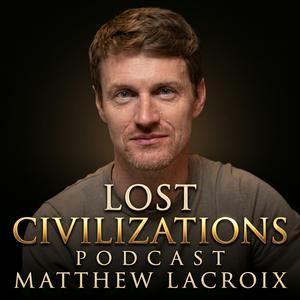
Om Lost Civilizations Podcast w/ Matt Lacroix
The Lost Civilizations Podcast, hosted by Matthew LaCroix.
Our history has a beginning that does not hold up. At sites on every continent, precise hard-stone construction with no mortar and no writing sits underneath the crude work of the cultures credited with building it. This show goes to the stones and asks the question the textbooks skip: who built the bottom layer, and when?
Every episode lays out physical evidence across the disciplines that rarely talk to each other: geomorphology, geology, climatology, masonry, archaeology and ancient symbols.
Podcast-webbplatsLyssna på Lost Civilizations Podcast w/ Matt Lacroix, Historiepodden och många andra poddar från världens alla hörn med radio.se-appen
Hämta den kostnadsfria radio.se-appen
- Bokmärk stationer och podcasts
- Strömma via Wi-Fi eller Bluetooth
- Stödjer Carplay & Android Auto
- Många andra appfunktioner
Hämta den kostnadsfria radio.se-appen
- Bokmärk stationer och podcasts
- Strömma via Wi-Fi eller Bluetooth
- Stödjer Carplay & Android Auto
- Många andra appfunktioner

Lost Civilizations Podcast w/ Matt Lacroix
Skanna koden,
ladda ner appen,
börja lyssna.
ladda ner appen,
börja lyssna.
 Sverige

