
Lyssna på den här podden kostnadsfritt i appen: Ladda ner gratis i App Store
radio.se
Sleeptimer
Spara kanal
59 avsnitt
Low-ABV IPAs Don't Have to Lack Body with Sean from Aslin Beer Company
2026-11-10 | 35 min.Low-ABV IPAs are notoriously difficult to pull off. Strip away the malt and alcohol, and you usually end up with a thin, hop-water mess.
Building legitimate palate weight in a 4% or 4.5% session beer requires a complete rethinking of grist design, yeast selection, and body-enhancing brewing tools.
In this episode, Richard sits down with Sean Gorzynski, Head Brewer at Aslin Beer Company, Virginia Beach. Drawing from his brewing experience at Lagunitas and Troegs to his current work at Aslin, Sean walks through a recent MBAA conference collaboration beer (the aptly named, "Conference Beer 1.5") designed specifically to conquer the low-ABV thinness trap.
In this episode, we break down:
The Low-ABV Grist Strategy: Using 24% flaked oats alongside chit malt and pilsner malt to construct a heavy protein foundation.
Boosting Viscosity: How adding ISY Enhance (an inactivated yeast product) in the whirlpool at 80g/bbl transforms small beer mouthfeel.
Fermentation & Hop Synergy: Free-rising Pomona yeast to 70ºF to unlock intense pineapple, tropical, and stone fruit esters alongside Southern Hemisphere hops.
From 4% to DIPA: How Sean harvested the same Pomona pitch for a heavy-hitting Hazy Double IPA paired with paw paw and vanilla custard flavour additions.
Featured in this Episode:
To learn more about LalBrew Pomona, our dry yeast collaboration with Lallemand Brewing, visit escarpmentlabs.com/products/lalbrew-pomona.
Explore the body-enhancing capabilities of ISY Enhance at escarpmentlabs.com/products/abv-isy-enhance.Oats and Mash Temp Aren't the Only Ways to Build Body
2026-11-03 | 32 min.When a beer tastes thin or lacks body, brewers usually tweak their mash temperature or pile on flaked oats. But are you ignoring the biological driver of beer viscosity sitting right inside your fermenter?
Glycerol is the most abundant fermentation byproduct in beer after water, ethanol, and carbon dioxide. It provides natural viscosity, roundness, and palate weight—softening alcohol warmth and smoothing out aggressive hop bite. But glycerol production isn't random; it's a hardcoded survival mechanism dictated by yeast genetics and fermentation stress.
In this episode, Mark and Richard open up the lab vault to share findings from a 46-strain screening and a dedicated 12ºC cold-fermentation lager trial.
In this episode, we break down:
The Glycerol Hierarchy: Why bone-dry Saisons (Farmstand Saison) and robust Kveiks (Hornindal) naturally produce the highest glycerol levels to compensate for low residual sugars or high-gravity stress.
The Hazy IPA Illusion: Why Foggy London actually produces less glycerol than Vermont Ale, relying on unfermented sugars for sweetness rather than true biological viscosity.
The Lager Divide: How bottom-fermenting strains diverge into distinct textural tiers—from ultra-crisp baselines (3470, Mexican Lager) to plush, velvety options (Copenhagen Lager, Staffelberg).
4 Cellar Levers for Body: How original gravity, pitch rate, temperature, and FAN levels can be tuned to actively push glycerol synthesis higher or lower.
Featured in this Episode:
Check out our Knowledge Base article, "Glycerol Production in Beer Yeasts".
Review episode S06E04, "Stop Treating Lager Yeast Like It's Always Neutral", or read our blog post, "18 Lager Yeasts Under the Microscope: What Our Latest Trial Taught Us About Flavour and Performance".Stop Treating Lager Yeast Like It's Always Neutral!
2026-10-27 | 29 min.Is 34/70 really the end-all-be-all of lager brewing, or are you leaving distinct flavour profiles on the table?
While ale cellars enjoy an endless playground of expressive strains, lager brewing has spent decades anchored to a near-monoculture. But as craft lagers evolve, brewers are actively seeking new ways to differentiate their pilsners, helles, and dark lagers.
In this episode, Mark and Richard open up the lab vault to share findings from a comprehensive University of Guelph trial comparing 18 distinct lager yeasts—tracking fermentation kinetics, sugar attenuation, and aroma compound profiles via GC headspace analysis under standardized 12ºC conditions.
In this episode, we break down:
Kinetics vs. Flavour: Why most Frohberg-type strains show remarkably similar gravity and pH curves, yet produce drastically different flavor profiles.
The 3 Flavour Clusters: How GC analysis categorized strains into Neutral (blank canvas), Expressive (orchard fruit & subtle esters), and Saaz-type Outliers.
The Ultra-Attenuator: Why Superlager reached 86.5% attenuation, making it ideal for bone-dry West Coast Pilsners or Mexican Lagers.
Surprise Standouts & Lab Mistakes: The story behind Premium Pils (a fast-fermenting S. cerevisiae "lager" yeast)—plus why Richard takes full personal responsibility for accidentally dropping Biergarten Lager from the trial!
Featured in this Episode:
For any of the lager (or ale strains, in the case of Premium Pils!), you can check out our Lager Collection.
Read the full trial data and blog post, "Under the Microscope: Comparison of 18 Lager Yeasts" on our website.Busted or Confirmed? Putting 5 Classic Brewing Myths to the Test
2026-10-20 | 30 min.Are the "golden rules" in your brewhouse actually rooted in science, or are they just leftover dogma from 40 years ago?
Many traditional brewing guidelines were completely true back when malts were less modified, yeast handling was imprecise, and hop processing was in its infancy. But thanks to modern maltsters, hop breeders, and yeast scientists, many of those old rules no longer apply.
In this special Mythbusters-inspired episode, Mark and Richard turn off the Yeast Lightning Round timer and take the time to bust common brewing myths once and for all.
We tackle:
Myth 1: Three Hop Additions: Do you really need early, middle, and late kettle additions for optimal hop aroma?
Myth 2: Pressure Fermentation: Is pressure fermentation an absolute requirement for clean homebrews and lagers?
Myth 3: Hot Side Aeration (HSA): Is HSA still a threat with modern malts and brewhouse equipment, or an overblown fear?
Myth 4: Complicated Recipes: Why simple grist profiles often outperform complex 10-grain bills.
Myth 5: Yeast Versatility & Tradition: Can modern, non-traditional yeast strains deliver authentic classic beer styles?
Bonus Rapid Fire: Dry vs. liquid yeast, the Carafoam necessity myth, and whether hop quality trumps varietal name!CPG Lessons for Craft Breweries: Non-Alcoholic, Functional Beverages, and Brand Extensions with Birdway CPG
2026-10-14 | 55 min.How can breweries leverage their fermentation expertise, equipment, and brand loyalty to expand beyond beer without losing their core identity?
The craft beverage landscape is evolving fast, and more breweries are becoming "CPG curious." Whether exploring non-alcoholic options, functional pre/pro/postbiotic drinks, energy beverages, or protein trends, moving into new categories brings real operational and brand challenges.
In this episode, Richard sits down with Sara Heitmann (Brand Marketing & Strategy) and Dan Beaudoin (Product Development & Food Manufacturing, ex-AB InBev) from Birdway CPG. Together, they break down what craft breweries can learn from the wider consumer packaged goods world, examining case studies of non-beer fermentation ventures, product expansion pitfalls, and how brewery skillsets naturally translate into broader food and beverage innovation.
In this episode, we cover:
What to Brew (and What to Avoid): Evaluating brand extensions—from waters and functional pre/postbiotics to energy drinks and "protein-maxxing."
Translating Brewer Skills: Why experience in mass-scaling, fluid handling, and sanitary cellar operations makes brewers prime innovators in food tech (including alternative seafood and beyond!).
Product Development SOPs: Starting small, running customer-facing pilot tests, and embedding strict food safety protocols into non-beer innovation.
Spotting Trends Early: How to track broader F&B movements using industry resources like Snaxshot and Natural Products Expo West.
Featured in this Episode:
Learn more about Birdway CPG at birdwaycpg.com
Fler podcasts i Vetenskap










Trendiga poddar i Vetenskap


























Om The Escarpment Labs Podcast
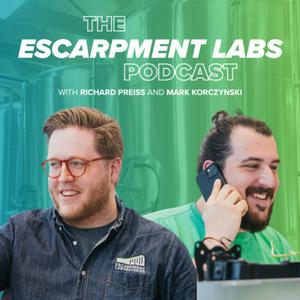
Welcome to The Escarpment Labs Podcast— a weekly podcast that brings you deeper into the science and strategy behind exceptional fermentation. Hosted by Sales Coordinator Mark Korczynski and CEO Richard Preiss, each episode explores popular topics from Escarpment’s blog and Knowledge Base with fresh insight, research updates, and brewer-focused tips.
Whether you're a homebrewer looking to level up or a professional chasing consistency and flavour precision, this show has something for every fermentation nerd. New episodes every Tuesday!
Podcast-webbplatsLyssna på The Escarpment Labs Podcast, The Rest Is Science och många andra poddar från världens alla hörn med radio.se-appen
Hämta den kostnadsfria radio.se-appen
- Bokmärk stationer och podcasts
- Strömma via Wi-Fi eller Bluetooth
- Stödjer Carplay & Android Auto
- Många andra appfunktioner

 Sverige

