PoddsändningarNäringslivOut of the Lab: Operationalizing Cell and Gene Therapy

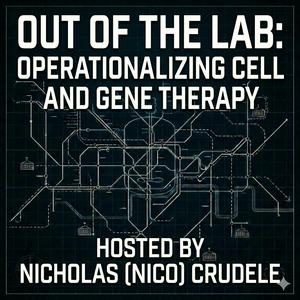
Out of the Lab: Operationalizing Cell and Gene Therapy

Nicholas (Nico) Crudele
Out of the Lab: Operationalizing Cell and Gene Therapy
Senaste avsnittet

21 avsnitt

  • Out of the Lab: Operationalizing Cell and Gene Therapy

    Laying the Rails for Advanced Therapies: Paul Chun on Cell & Gene Operations

    2026-03-11 | 1 h 1 min.
    In this episode, we sit down with guest Paul Chun to explore the complex operational challenges within the cell and gene therapy sector. Chun grounds the conversation in the powerful story of Melinda Bachini, the first GI tumor patient to receive tumor-infiltrating lymphocyte (TIL) therapy for cholangiocarcinoma. Despite her success over a decade ago, Chun explains why this life-saving process remains largely inaccessible.

    We dive deep into the business and operational hurdles of biotech, discussing why companies often pass on niche diagnoses, the intense resource realities of clinical trial design, and why high attrition rates mean fewer than one in ten eligible patients actually make it to treatment. Chun also breaks down the geographic and manufacturing bottlenecks that persist today, noting that while industry leaders have massively expanded their manufacturing capacity, upstream bottlenecks and "last mile" access issues keep actual market adoption plateaued. Discover how new models building standalone clinics aim to expand the catchment area for patients, and learn about the biotech social contract that justifies the cost of high innovation.

    Chapters / Timestamps:

    0:00 - 00:33: Introduction and a look at operational challenges in cell and gene therapy.

    00:33 - 03:33: The story of Melinda Bachini and the specific challenges of cholangiocarcinoma.

    03:33 - 06:14: Operational and clinical advocacy, featuring Dr. Simon Turcotte's role in Bachini's treatment.

    06:14 - 09:55: Biotech investment, market dynamics, and how patient advocacy shifts the calculus for niche diagnoses.

    09:55 - 14:30: Clinical trial design realities, high patient attrition rates, and new TCR-based developments.

    14:30 - 17:15: Geographic barriers, the high burden of finding trials, and patient access.

    17:15 - 21:18: Manufacturing capacity expansion vs. upstream bottlenecks and market adoption.

    21:18 - 28:54: Solving the "last mile" with new clinical models like NexCure.

    28:54 - 34:10: Supply chain risks in the last yards of the last miles and cultural shifts among specialists like rheumatologists.

    34:10 - 41:25: The "railroad" infrastructure analogy and the complications of cross-border trial participation.

    41:25 - 51:44: Financial friction at clinical centers and RA Capital’s "biotech social contract".

    51:44 - 01:01:20: The high-risk nature of biotech and the critical power of patient stories.
  • Out of the Lab: Operationalizing Cell and Gene Therapy

    You Don't Know What You Don't Know: The Hidden Traps in Tech Transfer with François-Xavier Lacasse

    2026-02-24 | 21 min.
    Why does a process that works perfectly in a university lab suddenly fail when it hits a manufacturing facility?

    In this episode, we sit down with François-Xavier (FX) Lacasse, a 28-year industry veteran, to unpack the notorious friction of tech transfer.

    We dive into the fundamental language barrier between academia ("research for research") and industry ("research for development"), and why strict GMP/GLP compliance is such a difficult bridge to cross.

    FX shares some brilliant analogies to explain the reality of scaling up like why changing the pan you’ve cooked a recipe in for 15 years suddenly ruins the dish, or how failing to document a seemingly obvious detail (like the exact temperature of the water) leads to massive reproducibility failures in biotech with a much higher cost than a burnt omelet.
    Ultimately, it comes down to a simple truth: you don't know what you don't know.

    In this episode, we cover:
    - Understanding the physical realities of scaling from an Eppendorf tube to a bioreactor.
    - The danger of tacit knowledge and unwritten steps in Standard Operating Procedures.
    - Why documentation is the ultimate crux of successful tech transfer.
    - How early-stage oversights compound into massive costs during clinical trials.
    Show Notes:
    [00:00:22] – Introduction: FX’s background and 28 years of experience in pharmaceutical development.

    [00:01:26] – The Language Barrier: Understanding the massive gap between "Research for Research" (academia) and "Research for Development" (industry).

    [00:02:27] – Why you must involve Contract Development and Manufacturing Organizations (CDMOs) as early as possible to anticipate operational pitfalls.

    [00:04:21] – The Water Temperature Dilemma: How unwritten, tacit knowledge ruins reproducibility when handing off a procedure to another operator.

    [00:07:35] – Why comprehensive documentation is the absolute "crux of the matter" in tech transfer.

    [00:12:42] – The massive financial impact of failing to document operational details before hitting multi-million dollar clinical trials.

    [00:18:59] – The "Cooking Pan" Analogy: Why scaling up from an Eppendorf tube to a bioreactor breaks your process due to heat and mass transfer changes.

    [00:20:10] – "You don't know what you don't know" – Uncovering the hidden traps in early-stage process development.

    Connect with us on LinkedIn:
    Nicholas Crudele (host): François-Xavier (FX) Lacasse (guest):learn how Method Made addresses documentation challenges for tech transfer:
  • Out of the Lab: Operationalizing Cell and Gene Therapy

    Decentralizing the Cure: The Road to Community-Based CAR-T

    2026-02-21 | 1 h 3 min.
    In this episode, host Nico sits down with repeat guest Lee Buckler to tackle the "80/20" problem in cell and gene therapy: the fact that while 80% of patients are treated in community settings, CAR-T therapies are currently stuck in high-level academic centers.
    We explore the history of patient access from the stem cell transplant model to the lessons learned from Dendreon’s Provenge and map out the infrastructure needed to bring these cures to the local level.

    From the "10-mile rule" of patient attrition to the massive financial hurdles of carrying multi-million dollar therapies on a hospital’s books, this conversation digs into the operational reality of scaling life-saving science

    Key Discussion Points
    The 10-Mile Rule: Why every 10 miles of distance from a treatment center results in a 6.2% drop in the likelihood of a patient receiving CAR-T.

    Infrastructure vs. Business Hurdles: Analyzing why the $500,000 to $3 million upfront cost of therapy creates massive cash-flow barriers for community hospitals.
    Decentralizing the "Vein-to-Vein" Process: How Blood Centers of America (BCA) and FACT are establishing new standards for local apheresis and infusion.

    Safety and Remote Monitoring: How wearable tech and reduced FDA REMS requirements are allowing patients to recover at home sooner.

    The Future of Cost: A look at how non-profit models and 5-year ROI data are shifting the payer landscape.
    Show Notes
    00:21 – The dual history of cell therapy: Stem cell transplants vs. Provenge.
    05:43 – The community access gap: Why CAR-T sales have plateaued at 20%.
    11:48 – Expanding into autoimmune: Why local delivery is no longer optional.
    19:30 – Logistics and Cryopreservation: Building a national infrastructure.
    34:33 – Financial bottlenecks and the reality of reimbursement.
    51:41 – Advancements in remote monitoring and patient safety.
    58:48 – Insurance, ROI, and the rise of generic models.
  • Out of the Lab: Operationalizing Cell and Gene Therapy

    Tech Transfer Trauma: The High Cost of Going Back to the Bench

    2026-02-15 | 26 min.
    In the current investment landscape, the "cool science" era of Cell and Gene Therapy is over. Investors have moved from unbridled optimism to rigorous risk management, yet many IP-backed companies still treat manufacturing as an afterthought, a strategic error that kills margins and delays clinics.

    In this episode, Nico sits down with Silvio Tiziani, CEO of CCRM Australia, to dissect the "Manufacturability Gap": the critical friction point where regulatory complexity and documentation failures amplify costs.

    We discuss the business case for early operational rigor, including:

    The Financial Reality of Rework:
    Why failing to consider GMP requirements during R&D leads to the ultimate nightmare scenario: returning to the lab bench for total process redesign.

    The "Widget" Investment Thesis:
    Silvio explains why the Australian market favors modular, versatile "widgets" over the "single magic box" approach and why this versatility makes for a more attractive, de-risked financial asset.

    From Founder to Executive:
    The necessary mindset shift from academic curiosity to commercial competence, and why your pitch must pivot from "technical novelty" to "risk management" to resonate with today's circumspect investors.Join us to learn how to transform operations from your biggest liability into your greatest asset.
  • Out of the Lab: Operationalizing Cell and Gene Therapy

    The 80/20 Gap: Why Life-Saving Cures Are Stalling (Teaser)

    2026-01-28 | 10 min.
    "The number one hashtag on everybody's lips is patient accessibility."

    In this pre-episode teaser, we dive into the sobering reality of the "80/20 Gap" in cell and gene therapy.

    While the industry has celebrated the arrival of highly curative CAR T-cell therapies, a massive logistical wall has been hit. Lee Buckler joins us to unpack why sales of these "wonderful widgets" are flattening just as they should be scaling.

    We discuss:
    The Geographic Divide: Why 80% of cancer patients treated in community healthcare settings are effectively locked out of therapies available only at advanced medical centers (AMCs).

    The flattening of CAR T: A look at why adoption has stalled at 20%—the exact percentage of patients with easy access to city-center hubs.

    Beyond the Science: Why the "attractive option" of a cure disappears when a patient faces a five-hour drive, three weeks of city living costs, and a lack of local support systems.

    The Path to Decentralization: How "boxed-in" physical systems and operational engineering are working to bring manufacturing and processing closer to the patient’s home.

    If we don't move the therapy to the patient, we leave 80% of the population behind. Join us as we explore the infrastructure and "contractual engineering" required to break CAR-T out of the ivory tower and into the community. Stay tuned for the full episode.

Fler podcasts i Näringsliv

Om Out of the Lab: Operationalizing Cell and Gene Therapy

tech transfer, process control, travel requirements, audits These silent operational breakdowns prevent life-saving cell and gene therapy treatments from ever reaching patients, and kill IP-backed companies. This show is for executives on the path to clinic, de-risking their clinical assets. Leverage insights hard-earned from countless years in the industry, ranging from the manufacturing floor through to leadership. Transform operations from your biggest risk into your greatest asset. See, understand and prepare for the challenges ahead on your clinical journey.
Podcast-webbplats

Lyssna på Out of the Lab: Operationalizing Cell and Gene Therapy, Fill or Kill och många andra poddar från världens alla hörn med radio.se-appen

Hämta den kostnadsfria radio.se-appen

  • Bokmärk stationer och podcasts
  • Strömma via Wi-Fi eller Bluetooth
  • Stödjer Carplay & Android Auto
  • Många andra appfunktioner
Sociala nätverk
v8.8.0 | © 2007-2026 radio.de GmbH
Generated: 3/17/2026 - 1:27:45 PM