

Lyssna på den här podden kostnadsfritt i appen: Ladda ner gratis i App Store
radio.se
Sleeptimer
Spara kanal
893 avsnitt
The Ascetical Homilies of St. Isaac the Syrian - Homily XX, Part II
2026-08-28 | 1 h 7 min.There is a sentence here from St. Isaac that overturns almost everything we are inclined to think about asceticism: You suppose these things were ordained simply to oblige you to labor.
We imagine the vigil primarily as something difficult. Sleep is surrendered. The body is constrained. Psalms are prayed while the world sleeps. Nature protests and the monk remains standing before God. Looked at from the outside, it appears to be an extraordinary act of discipline.
But Isaac tells us that if this is all we see, we have not yet understood the vigil.
The question is not how much a man can endure for God. The question is what begins to happen within the heart of a man who desires God enough to seek Him in the night.
Something is born there.
This is why Isaac speaks so fiercely about the following day. The tragedy would not simply be that we failed in some ascetical rule. The tragedy would be that we received something precious and then lived carelessly enough to lose it.
Seeking the One Who Has Already Come to Us
The night vigil is born from desire.
The monk rises because Someone is there.
This is what distinguishes Christian asceticism from mere religious exertion. We are not trying to force our way toward an absent God. We are responding to the God who has already drawn near, already called us, already awakened desire within us.
The Beloved has come seeking us.
And eventually the heart begins seeking Him.
There comes a moment in the spiritual life when prayer is no longer adequately described as obligation. The language of duty becomes too small. A man discovers within himself a hunger for silence because silence allows him to hear more clearly. He desires solitude because solitude removes the thousand competing claims upon his attention. He rises in the night because there are hours when the world has become quiet enough for the heart to recognize what it has always desired.
Isaac knows this experience.
This is why he speaks of Scripture as well. Reading is not merely preparation for prayer or the acquisition of religious knowledge. Scripture “sows” something within the soul. It gathers the scattered mind. It irrigates prayer. It plants the remembrance of God. It makes the understanding subtle enough to perceive things that previously escaped it.
Scripture, silence, prayer, vigil—all begin converging upon the one thing necessary.
Christ Himself.
And once the heart begins to taste this, the whole ordering of life must change.
The Day Must Become the Guardian of the Night
Here Isaac becomes extraordinarily demanding.
What sense is there, he asks, in sowing throughout the night only to scatter the seed during the day?
We stand before God in darkness, struggling to gather the mind. Perhaps after a long while the thoughts settle. Something softens. The Name descends more deeply. Scripture opens itself in a way that cannot easily be explained. A stillness appears that we could never manufacture.
Then morning comes.
And we throw ourselves back into dispersion.
Conversation. Curiosity. News. Opinions. Tasks that did not need to be done. Encounters that did not need to occur. Words that did not need to be spoken. The endless grazing of the mind among things.
Isaac’s question is devastatingly simple:
Why would you do this?
Why labor through the night to gather what you willingly scatter during the day?
This reveals something essential about the monastic heart. Vigil cannot be isolated from the rest of life. There cannot be one life before God and another life afterward. Isaac says that we must place “no wall of separation” between the night and the day.
That phrase is astonishing.
The stillness of the night is meant to flow into the day.
The remembrance of God cultivated in darkness must become the hidden atmosphere in which we move beneath the light of the sun. The silence of the cell must follow us. The Name must remain near. Our encounters, our speech, our work, even the manner in which we allow ourselves to think must begin to be governed by one question:
Will this help me remain with the One whom I have found?
This is not narrowness.
It is love.
Love Makes a Man Careful
When something becomes precious to us, we become careful around it.
This perhaps explains Isaac’s asceticism better than almost anything else.
The Fathers guard the senses because something precious has been entrusted to the heart. They guard speech because words can disturb what silence has gathered. They flee unnecessary encounters because the mind can quickly become populated by images, arguments, memories, anxieties, and judgments. They restrain curiosity because the heart cannot gaze simultaneously in every direction and remain simple before God.
From outside, such a life may appear severe.
From within, it is tenderness.
A man in love does not experience every renunciation as deprivation. Some things simply become less interesting because something infinitely more beautiful has appeared.
This is why the ascetical life is so counterintuitive. We ordinarily construct our days around what must be accomplished and then attempt to fit prayer somewhere within them. Isaac reverses the order.
Order the day around what must not be lost.
What if the most important thing that happened today occurred while the world was sleeping?
What if the deepest work was not something we accomplished but the quiet gathering of the heart before God?
What if the purpose of tomorrow were, in part, simply not to lose it?
Then discernment changes.
We begin asking not merely whether something is sinful, permissible, useful, interesting, or productive. We begin asking whether it preserves the heart’s capacity for God.
This is a much more demanding question.
“You Would Have Embraced Jesus’ Bosom”
And then Isaac says something almost unbearably beautiful.
Had the monk allowed his daytime life to correspond to the meditation of the night, had he placed no division between them, Isaac says that “in a short time you would have embraced Jesus’ bosom.”
Here the entire meaning of vigil is unveiled.
Not achievement.
Not spiritual heroism.
Not mastery over sleep.
The bosom of Jesus.
Communion.
Intimacy.
Rest in the Beloved.
Everything else exists for this.
We constrain ourselves because we desire freedom from everything that prevents love. We become silent because we desire to hear. We remain awake because we desire to see. We read because we desire the mind of Christ. We guard ourselves because we have discovered something worth guarding.
Even the night itself becomes sacramental in this sense. The darkness strips things of their urgency. The machinery of the world slows. The identities we carry during the day become less important. There is less to perform and less to defend.
There is simply the creature before the Creator.
The beloved before the Beloved.
And the Name.
Lord Jesus Christ.
The New Life Begins in the Night
Isaac finally speaks of those who desire “knowledge of the new life.”
That is what vigil opens before us.
A new life.
Not merely a more disciplined version of the old one.
Perhaps this is why the call to stillness can become stronger rather than weaker as the spiritual life deepens. The field of vision narrows. Things once regarded as indispensable reveal themselves as secondary. Activities that once seemed important begin to feel strangely weightless. Even good works must find their proper place.
Not because love has diminished.
Because desire has become concentrated.
One thing is necessary.
The night teaches this with a clarity the day rarely permits.
And so perhaps Isaac’s teaching on vigil reaches far beyond the question of how many hours we sleep. He is teaching us how to construct an entire life around the remembrance of God.
Receive the night as gift.
Read until the mind is gathered.
Call upon the Name.
Stand before God when nothing seems to be happening.
Remain.
And when something begins to awaken within you—some tenderness, some compunction, some clarity, some quiet awareness of the One who has been waiting for you—do not rush away from it.
Guard it.
Carry it into the morning.
Let your speech become quieter because of it. Let your choices become simpler. Let unnecessary things fall away. Let the day itself become an extension of the vigil.
For the purpose of the vigil was never simply that we should remain awake.
It was that we should awaken.
And having awakened, that we should refuse to return to sleep.
The Fathers went into the night because they had begun to glimpse the astonishing truth hidden beneath all asceticism:
God is worth seeking.
God is worth waiting for.
God is worth arranging an entire life around.
And once the heart has begun to discover Him in the silence, wisdom consists largely in learning not to lose during the day what Love has given us in the night.
---
Text of chat during the group:
00:21:49 Ambrose Little: It’s supposed to make your head hurt. 😄
00:23:34 Ryan Ngeve: Father could reading itself become a distraction from prayer
00:25:11 Maureen Cunningham: The :ight to mind
00:28:16 Bob Čihák, AZ: P 223, # 5, middle paragraph on page
00:37:28 Ben: Anna: My eldest daughter and I were chatting this morning and she remarked that some babies take longer to talk or walk if their parents are living in a constant state of stress, and it brought me to wondering how much a life of contemplative prayer would help parents to keep their peace in the midst of the trials that inevitably come.
00:41:46 Nypaver Clan: St. Charbel’s mother sang to him as a baby, “May he love fasting, may he love prayer….”
00:44:09 Nancy Pagan: Back then, raising my kids and doing my wifely chores of everyday life, while calling on the Lord constantly all day. at night by the time I sat alone to Practice, I didn’t have to search too much He was already there. However didn’t happen always. I apologize if this is confusing.
00:54:46 Julie: Father a retreat on night vigil would be great
00:57:39 jonathan: I always fell asleep during adoration, for some reason, the church has always been the most peaceful place on earth to nod off. Its like falling asleep on your parents lap.
00:59:59 jonathan: I am also guilty of falling asleep during these lessons, but no better way to fall asleep than listening to the words of the fathers.
01:01:57 Ben: Anna: Father Matteo Crawley-Boevey was promoting night adoration in the home for those not able to make it somewhere in a church. (My other question was answered by your answer to Julie)
01:07:33 Julie: So if Vigils are so pleasing to God we should be preparing our day around them for the graces receive during the day for our life and family how much more planting the seeds for the day
01:08:32 Erick Chastain: How do we deal with the effect of sleep deprivation from vigils on the increase in temptations?
01:10:06 Nypaver Clan: Reacted to "How do we deal with the effect of sleep deprivation from vigils on the increase in temptations?" with 👍
01:10:32 David Swiderski: I used to get up every night to feed both of my son's. My oldest was a baby during the first Iraq war. It was amazing I didn't think about the news, or anything the house was quite and often felt it was the "between" time. The past day ended the next had not begun. They were some of my favorite moments and when I do vigil I feel the same as when I used to hold them close to God and Love.
01:11:09 Julie: Reacted to "I used to get up every night to feed both of my son's. My oldest was a baby during the first Iraq war. It was amazing I didn't think about the news, or anything the house was quite and often felt it was the "between" time. The past day ended the next had not begun. They were some of my favorite moments and when I do vigil I feel the same as when I used to hold them close to God and Love." with ❤️
01:11:12 Eleana Urrego: Reacted to "I used to get up every night to feed both of my son's. My oldest was a baby during the first Iraq war. It was amazing I didn't think about the news, or anything the house was quite and often felt it was the "between" time. The past day ended the next had not begun. They were some of my favorite moments and when I do vigil I feel the same as when I used to hold them close to God and Love." with ❤️
01:11:40 Nypaver Clan: Reacted to "I used to get up every night to feed both of my son's. My oldest was a baby during the first Iraq war. It was amazing I didn't think about the news, or anything the house was quite and often felt it was the "between" time. The past day ended the next had not begun. They were some of my favorite moments and when I do vigil I feel the same as when I used to hold them close to God and Love." with ❤️
01:13:58 Ben: Anna: When is a vigil a vigil? After 10pm? before 4am? Is getting up an hour early a vigil?
01:14:42 Jesssica Imanaka: Replying to "Anna: When is a vigi..."
Great questions. Thanks!
01:18:19 David Swiderski: Thank you Father may God bless you, your mother, Ren and her Husband and everyone in this group.
01:18:29 jonathan: God bless father!
01:18:29 Jesssica Imanaka: Reacted to "Thank you Father may..." with ❤️
01:18:29 Nancy Pagan: Thank U
01:18:30 Maureen Cunningham: Thank you
01:18:37 Nancy Pagan: HeheThe Evergetinos: Book Three - Chapter IX, Part IV
2026-08-28 | 1 h 6 min.There is something almost frightening about the stories preserved for us in the Evergetinos. They are frightening not because they portray extraordinary wickedness, but because they reveal how quietly the heart can change.
The monk described by Palladios is not a beginner. He is a man of profound silence and prayer, one who has surrendered himself so completely to God that even the necessities of his bodily life have been entrusted to Providence. His life has become contemplation. Prayer is his delight. God provides for him in a miraculous manner. He has tasted something of the life of the age to come.
And yet the beginning of his fall is almost imperceptible.
He sleeps a little longer.
His prayer becomes somewhat shorter.
His attention wanders.
Earthly concerns begin to occupy a little more space within him.
Thoughts once immediately rejected are permitted to remain for a moment.
Nothing, at first, seems catastrophic.
That is precisely the warning.
The Fathers understood that the great falls of the spiritual life rarely begin as great falls. They begin with small permissions. Something formerly guarded carefully is treated casually. Something that once troubled the conscience is dismissed as insignificant. A thought is entertained rather than rejected. Prayer is postponed. Vigilance relaxes. A little comfort is allowed to become necessary. The heart whispers that such things hardly matter.
But they matter because the heart matters.
There is something extraordinarily precious hidden within the human person: the place of communion with God. The Fathers speak of guarding the heart so insistently because they know what has been entrusted to us. Grace has entered there. The Name has been received there. Desire for God has been awakened there. A fire has been kindled that does not originate in ourselves.
The spiritual life, therefore, is not primarily the anxious avoidance of infractions. It is the guarding of a treasure.
This changes how we understand vigilance.
We do not guard ourselves because God is waiting to punish the smallest mistake. We guard ourselves because love is delicate. Communion can be obscured. Desire can cool. The eye of the heart can become clouded. What has become luminous through prayer can gradually become opaque again.
The evil one understands this very well.
He does not always attempt to tear a person immediately away from God. With someone who has given himself deeply to prayer, such an assault might be too obvious. Instead, he waits. He works through what appears negligible. A little negligence. A little self-confidence. A little relaxation of watchfulness. A thought that seems harmless enough to entertain.
The enemy is patient because he knows that a heart need not renounce God explicitly in order gradually to lose sight of Him.
Palladios gives us an extraordinary image of this darkening in the bread.
At first the monk receives heavenly bread, pure and provided by God. As his interior life becomes disordered, the bread appears grimy and gnawed. Later it is almost entirely spoiled. What is happening visibly to the bread corresponds to what is happening invisibly within the monk. The gift has not ceased to be gift, but his capacity to receive it has become corrupted.
The tragedy is not simply that temptation has appeared. Temptation comes to everyone. The decisive moment comes earlier: he notices the diminishment and does not respond to it.
He regards the first symptoms as trivial.
This is one of the most penetrating insights in the story. The monk does not suddenly decide to abandon his vocation. He fails to take seriously the cooling of his love.
The Fathers would have us become sensitive to precisely this.
When prayer becomes burdensome, notice.
When mercy toward another begins to disappear, notice.
When resentment becomes pleasurable, notice.
When the imagination begins feeding upon something we would once have rejected, notice.
When silence becomes uncomfortable and distraction increasingly necessary, notice.
When we begin excusing in ourselves what once brought us immediately to repentance, notice.
Not because every movement of weakness is a catastrophe, but because small movements reveal the direction in which the heart is turning.
The story attributed to St. Maximos makes the warning still more sobering. The young monk possesses astonishing spiritual authority. Even wild animals obey him. Those around him naturally interpret such gifts as evidence of sanctity.
St. Anthony is less impressed.
He sees a ship filled with precious cargo and says, in effect: Yes—but will it reach the harbor?
Everything is contained in that image.
Grace received is not yet grace preserved.
Virtue acquired is not yet virtue safely possessed.
Spiritual gifts are not guarantees.
Years of asceticism are not guarantees.
Miracles are not guarantees.
The harbor is reached only through perseverance.
This is why Maximos interprets the command to “turn away from evil, and do good” as something more than the avoidance of sin. We must fight to diminish the passions; we must labor to acquire the virtues; and then—we must remain awake in order to preserve what has been given.
He connects this with Adam’s vocation in Eden: to cultivate and to keep.
The heart is a garden.
Grace cultivates it with us. Prayer waters it. Tears soften its soil. The remembrance of God makes it fruitful. Virtue slowly becomes something beautiful and living within us.
But the garden must also be kept.
Perhaps this is why the Fathers can appear severe about things modern people consider insignificant. Their severity is not necessarily born from fear. At its deepest, it arises from wonder.
They know what the heart can become.
They have seen human beings filled with God.
They have seen the mind made luminous through prayer, the passions transfigured, the hardened heart made merciful, and ordinary human beings become bearers of the Holy Spirit. Having seen such things, they cannot regard anything that gradually extinguishes that life as trivial.
The treasure is too precious.
And yet neither story finally teaches despair.
Palladios’ monk awakens. Remarkably, his awakening comes while he is teaching others. He hears himself speaking truths that he has ceased to live, and suddenly sees himself. The contradiction becomes unbearable. He runs back into the desert, casts himself upon the ground, and repents.
God receives him.
The angel’s words are filled with mercy: “God has accepted your repentance and has had mercy on you.”
Something has nevertheless changed. The miraculous bread does not return. His remaining years are marked by mourning. This is not because God refuses forgiveness. Rather, the story preserves the terrible seriousness of freedom. Forgiveness is complete, yet our choices are real. Grace is not magic, and repentance does not make our history unreal.
The Fathers hold together what we so often separate: immense mercy and immense seriousness.
Never despair.
But never presume.
Never imagine that a fall places you beyond the mercy of God.
But never imagine that what darkens the heart is therefore insignificant.
The Christian life is lived between these truths.
Perhaps the most important question, then, is not simply, Have I committed some great sin?
It may be much quieter:
What is happening to my desire for God?
Is the flame growing brighter or dimmer?
Is prayer becoming more truthful or merely habitual?
Is my heart becoming softer or harder?
Am I becoming freer to love, or increasingly absorbed in myself?
Have I begun calling “small” those things that slowly make me forget the One whom I love?
The evil one is willing to wait. He knows that great falls can grow from tiny seeds of forgetfulness.
We too must learn to wait—but differently.
We remain before God.
We keep the heart.
We cultivate the garden.
We guard the treasure.
And when we discover even the smallest cooling of love, we do not panic and we do not despair. We turn again toward Christ. Immediately. Simply. Humbly.
For vigilance, rightly understood, is not living in terror that we might lose God.
It is living with the knowledge that nothing is more precious than having found Him.
---
Text of chat during the group:
00:08:19 Fr. Charbel Abernethy: Page 61 Section C
00:14:06 Jacqulyn Dudasko: I received my books today! Even had a bit of time to start reading! 🙂
00:17:08 James Hickman: This will be my only day for a while: I’ll be working with the parish on Wednesday evenings, but I should be able to keep up on Mondays.
00:18:49 Fr. Charbel Abernethy: Page 61 Section C
00:58:18 James Hickman: The Lord in his strange yet beautiful goodness bestows on this fallen monk the great gift of compunction, bathing him with his tears. Our Father gives us “the revenge of mercy” (Archimandrite Mark Malone of Holy Transfiguration in McLean preached yesterday of this revenge of divine mercy).
01:10:14 Larry: Dont put off confession today
01:10:30 Nancy Pagan: Many concerns
01:11:47 James Hickman: Can we read it in an alternative light? He, if sincere, desired forgiveness. The Lord in mercy reduced his earthly suffering by five days, taking him, perhaps to heaven, a little early. In hope, can we lean on the Lord’s mercy for this young monk?
01:13:03 Larry: We have confession every day except Sunday and always long lines of people waiting.
01:13:06 James Hickman: Certainly for me I don’t want to presume for me. But for others deep hope.
01:13:08 Anna: It's a great suffering when priests aren't willing to be present for confession outside the line that's so minimal weekly.
01:19:15 Nancy Pagan: Christ the King Monastery in Cullman AL everyday before 8am Mass.
01:23:21 Anna: If we all were radically accessible for souls, wow what graces
01:24:34 Maureen Cunningham: Thank You, Blessing
01:24:39 Janine: Thank you Father!
01:24:51 Nancy Pagan: Thank you FrThe Ascetical Homilies of St. Isaac the Syrian - Homily XX
2026-08-28 | 1 h 2 min.There are passages in St. Isaac that can sound almost impossible to modern ears. His words on vigil are among them.
“Do not imagine,” he tells us, “that among all the works of monastics there is any practice greater than night vigil.”
We hear such words and immediately think of sleep deprivation, bodily exhaustion, long hours of psalmody, standing in darkness while the rest of the world sleeps. We wonder whether such a practice belongs to another age, another kind of human being, perhaps even another understanding of the spiritual life.
But this is precisely where we can misunderstand Isaac.
Vigil becomes incomprehensible when it is separated from desire.
If we begin with asceticism, vigil appears severe. If we begin with love, it begins to make sense.
The lover understands the night.
There are moments when we do not want an evening to end because we are with someone we love. There are conversations in which we cease looking at the clock. A mother remains awake beside a sick child without calculating the sacrifice. Someone awaiting the return of the beloved listens for every sound in the night.
Love changes our experience of time.
And so it is with the saints.
They did not remain awake because they despised sleep. They remained awake because they had discovered Someone for whom it was worth losing sleep.
This is the secret of vigil.
“That I May Be With You”
The Fathers understood the spiritual life far less as the fulfillment of religious obligations than as the awakening of desire. Beneath fasting, silence, solitude, tears, prostrations, psalmody, and vigil lies a single movement of the heart:
I want God.
Not merely His gifts.
Not consolation.
Not religious experiences.
Not even virtue considered as a possession.
God Himself.
This is why St. Isaac describes the mind of the one who keeps vigil as becoming light and buoyant, taking flight “as it were on wings.” The ascetic is not merely staying awake. Something within him is being released.
During the day the mind is scattered among a thousand things. We speak. We answer. We plan. We remember. We anticipate. We defend ourselves. We attend to necessities. Even when these things are good, the heart becomes divided among them.
Then comes the night.
The voices diminish.
The demands cease.
The world grows quiet.
And the soul discovers again the One whom it has been seeking beneath everything else.
This is why vigil was so precious to the Desert Fathers and remains so in the teaching of the great modern elders. It creates a space in which the heart can become undivided.
The night says:
There is nowhere else I need to go.
There is nothing I need to accomplish.
There is no one before whom I need to justify myself.
There is only God.
And I am here.
The Recovery of Wonder
Yet there is something even deeper in Isaac’s teaching.
Vigil is not merely about attention.
It is about wonder.
Isaac tells us that the one who perseveres in vigil begins to “gaze upon” heavenly realities. His language is deliberately extravagant: the soul comes to possess “the eyes of Cherubim.”
What does this mean?
It means that purification changes how we see.
The tragedy of fallen existence is not simply that we commit sins. It is that we gradually cease to be astonished by God.
We become accustomed to everything.
Accustomed to the Gospel.
Accustomed to the Eucharist.
Accustomed to the name of Jesus.
Accustomed to the Cross.
Accustomed even to the astonishing claim that the Creator of heaven and earth desires communion with us.
And when wonder disappears, desire soon weakens with it.
The Fathers knew that the heart must be awakened again.
This is one reason vigil has such power. In the silence of the night, familiar words can suddenly become new.
“Lord Jesus Christ, Son of God…”
We may have spoken those words ten thousand times.
Yet in the stillness something can happen.
Jesus.
The Name becomes luminous.
God is here.
God sees me.
God desires me.
God has called me into existence that I might share His life.
And suddenly prayer is no longer something we are performing.
It is encounter.
Wonder gives birth to desire, and desire gives birth to greater attention.
Then the soul begins to understand why the saints stayed awake.
The Vigil of the Lover
This is why we must be careful not to turn Isaac’s teaching into another spiritual program.
Stay awake longer.
Say more psalms.
Sleep less.
Accumulate hours.
Isaac himself warns against precisely this distortion. A person may endure “prolonged psalmody,” weariness of the tongue, and “night-long standing,” and yet receive little fruit because the mind is elsewhere.
The body is standing before God while the heart is wandering through the world.
Isaac asks, with characteristic directness: Why sow so much seed if we continually prevent it from bearing fruit?
Vigil without attention becomes habit.
Vigil without desire becomes endurance.
Vigil without love becomes religious achievement.
And religious achievement can quietly feed the very ego that asceticism is meant to dismantle.
The true vigil begins somewhere deeper.
Stay with Me.
This is the invitation hidden within the night.
Christ in Gethsemane asked His disciples, “Could you not watch with me one hour?”
Perhaps every vigil is, in some mysterious way, our answer to that question.
Yes, Lord.
I will stay.
Not because I am strong.
Not because I am an ascetic.
Not because I want to imagine myself among the saints.
I stay because You are here.
Why Vigil Requires the Day
This also explains something that Isaac emphasizes strongly and that can easily be overlooked.
The vigil cannot be separated from the way we live during the day.
If we spend the day deliberately filling the mind with noise, agitation, curiosity, argument, distraction, and endless encounters, we should not be surprised if those same things accompany us into prayer at night.
Isaac therefore insists that the monk who desires the fruit of vigil must guard himself from unnecessary disturbance during the day.
This is not contempt for the world.
It is custody of the heart.
The Fathers understood something about human consciousness that our age desperately needs to rediscover: what we give ourselves to leaves traces within us.
Everything enters the heart.
Images.
Conversations.
Arguments.
News.
Resentments.
Fantasies.
Fears.
The opinions of others.
The desire to be seen.
The need to respond.
The mind carries these things into silence.
Thus vigil actually begins long before nightfall.
It begins with how we guard the heart throughout the day.
The School of Freedom
This is one reason the disappearance of vigil from much contemporary Christian life is significant.
We have not merely lost an ascetical practice.
We have lost one of the great schools of desire, attention, and freedom.
The modern world teaches us to flee silence. It places a device in our hand capable of filling every empty moment. It trains the eyes to seek novelty and the mind to expect constant stimulation.
The Fathers move in precisely the opposite direction.
Be still.
Remain.
Watch.
Wait.
Listen.
Do not flee the emptiness.
Because eventually you may discover that it was never empty.
Someone was waiting for you there.
The purpose of vigil is not to prove that we can conquer the body. It is to become free enough to recognize the presence of the Beloved.
“I Sleep, but My Heart Is Awake”
The goal, then, is ultimately something greater than remaining physically awake.
The goal is wakefulness of heart.
“I sleep, but my heart is awake,” says the Bride in the Song of Songs.
There is the mystery.
The deepest vigil eventually becomes a state of the soul.
A person begins to live before God.
The Jesus Prayer continues beneath thought.
The remembrance of God becomes increasingly continuous.
The heart waits for Him.
Looks toward Him.
Listens for Him.
Desires Him.
This is the angelic quality Isaac sees in vigil. The angels do not merely “stay awake.” They exist in ceaseless attention to God.
Their life is beholding.
And Isaac dares to say that through vigil the human person begins to participate in this same movement.
The eyes of the heart open.
Wonder returns.
Desire intensifies.
Prayer deepens.
The mind grows light.
And gradually the soul discovers that the ascetical life is not fundamentally a life of deprivation.
It is a life of fascination.
The Night Is Not Empty
Perhaps this is what we most need to recover from Isaac.
We will never understand the asceticism of the Fathers if we begin with what they gave up.
We must begin with what they saw.
They saw a Beauty before which the beauties of the world grew pale.
They tasted a sweetness that made lesser consolations seem small.
They discovered a Love so immense that solitude became communion, silence became fullness, fasting became hunger for God, and vigil became the refusal to leave the presence of the Beloved.
This is why the teaching on vigil belongs so naturally beside the language of desire and wonder.
The ascetic does not remain awake merely because a rule commands it.
He has glimpsed something.
And because he has glimpsed it, he wants to see more.
Wonder awakens desire.
Desire gathers the scattered heart.
The gathered heart becomes attentive.
Attention becomes prayer.
And prayer becomes communion.
Then something remarkable happens.
What once appeared burdensome becomes precious.
The night that once seemed long becomes too short.
Silence that once frightened us becomes the place we long to enter.
And the prayer that once seemed an obligation becomes something from which we are reluctant to depart.
The saints kept vigil because they discovered that the night was not empty.
The Beloved was there.
And once the heart knows this, the deepest question is no longer:
Why would anyone remain awake to pray?
It becomes:
How could love not want to remain?
---
Text of chat during the group:
00:18:08 Bob Čihák, AZ: P 222, Homily 20
00:23:28 David Swiderski: The last time we discussed this and sleeping 8 hours straight and for most of time people at least in Europe slept "2" times I went back to my Grandfather's diary and it appears the wood stoves in Northern Wisconsin only lasted 4hrs and you would need to get up and feed the fire so they naturally did vigils and took advantage of the break in sleep. In Spain and Latina America they have a nap in some areas due to the heat (2 hour lunch) and are up till 1 or 2 am. It seems modern western society is a new adaptation of what was a practice for hundreds of years.
00:25:10 Ryan Ngeve: Father what is one to do if these practices and deprivations make us more agitated/irritated and downcast, especially towards others, as they tend to do?
00:39:01 Gwen’s iPhone: my cat does!
00:39:24 James Hickman: Is it safe to call vigils a means to the end, which is nearness to the Lord, such that a super practical means to find closeness with the Lord is this watching for him when there are fewer distractions (not that we are safe from distractions in the night, but that the many combating us in the day are perhaps different in kind or number than those distractions of the night)?
00:42:15 Rod Castillo: I pray my daily rosary at 2 am. It’s the only time the house is quiet enough to allow me to devote myself completely to it.
00:43:46 James Hickman: Reacted to "I pray my daily rosary at 2 am. It’s the only time the house is quiet enough to allow me to devote myself completely to it." with 🫡
00:48:52 David Swiderski: Just one other thing I am embarrassed about. A protestant friend and I were discussing the real presence in the tabernacle and adoration and he bluntly told me if you really believed that why don't you stop at any church during the day just to say hello and ask for forgiveness. I really felt a lot of shame he is right. This was really common when I lived in Mexico people would just stop after lunch, on the way home for traffic to die down and do a short prayer along the way. Made me really think and have been trying to do this more when possible. My mind makes it out to be such a huge disruption but I have been going to stores closer to where they have adoration and always feel better after just 5 minutes which I waste all the time in traffic or other things and still struggle to do this more. It seemed easier in Mexico where all my friends and even some clients would just drop in but there 95% of churches are catholic so you don't need to look far.
00:49:14 Myles Davidson: Reacted to "I pray my daily rosa..." with ❤️
00:52:49 Tracey Fredman: For those who say we shouldn't read the desert fathers might not be aware that the Rule of St. Benedict mentions them: "As for those who are hurrying toward the perfection of conversation, there are the teachings of the fathers whose observance may lead a person to the heights of perfection. For what page or what word of divine authority in the Old or New Testament is not the most perfect standard of human life? Or what book of the holy, catholic fathers does not resound with this, so that we may, by this straight path, reach our Creator? 5 Are there not the Conferences of the Fathers and their Institutes and Lives as well as the Rule of our Holy Father Basil?"
00:53:56 Tracey Fredman: Benedictine Oblates study the rule, even today.
00:56:07 James Hickman: Father, your chapter for priest pastors in The Monastic Heart really made me think so many American pastors need to take a week off and read that one chapter a few times.
00:56:25 James Hickman: The chapter after The Domestic Church
00:57:18 James Hickman: Reacted to "Benedictine Oblates study the rule, even today." with 💯
00:59:16 Maureen Cunningham: I Knew a man he was 85 he would awake art 3:00 am for years he had so much joy and he always said why would"t you get up. It is all joy
01:08:11 Janine: I feel like this was a retreat!
01:08:53 Eleana Urrego: Thank you
01:08:53 David Swiderski: I have been practicing psalmody on a holy hour on Friday and have looped through the sections (orthodox) a few times. It seems when I love others or make sacrifices it is like I see something else I never saw before. While some are repetitious a lot depends what I did during the week.
01:10:04 David Swiderski: My Mom used to call me David or Beloved interchangeably and since the psalms are from David well it really hits me
01:11:03 Janine: Yes! It’s beautiful
01:11:11 Janine: Lent
01:11:18 Melanie: It’s been my experience that anxiety about lack of sleep is much more tiring than actual lack of sleep. This is relevant in my work as a lactation consultant… helping moms to see that waking at night to feed their babies will not make them perish of exhaustion. Similar with vigils. <3
01:15:25 Rebecca Thérèse: Thank you☺️
01:15:29 Maureen Cunningham: Thank you sure please send it PDfThe Evergetinos: Book Three - Chapter IX, Part III
2026-08-28 | 56 min.There is something almost relentless about the teaching of the Fathers on watchfulness. They will not allow us to imagine that there comes a point in the spiritual life when vigilance is no longer necessary. Age does not free us from it. Knowledge does not free us from it. Years of prayer do not free us from it. Even great spiritual gifts do not free us from it.
“As long as you are in the body, do not leave your heart unguarded.”
Until the last breath.
At first this can sound severe. The image given by Abba Isaiah is striking: he is like a sparrow tied by the foot. It may fly upward and imagine itself free, but the cord remains. A single tug can bring it back to the earth. Likewise, the Fathers tell us that the enemy waits at the crossroads, lays traps along the path, makes use of small thoughts and seemingly insignificant compromises, and patiently seeks an opening into the heart.
Yet if we read these sayings merely as a catalogue of demonic strategies, we have misunderstood their purpose.
The Evergetinos is not trying to make us fascinated with evil. Nor are the Fathers trying to produce souls that are perpetually looking over their shoulders, anxiously examining every movement of the heart. They are teaching us watchfulness because they desire something infinitely greater for us.
They want us to discover how precious the heart is to God.
Indeed, hidden within these rather frightening descriptions is one of the most beautiful statements in the entire passage. The enemy himself is forced to confess concerning the monks:
“You and your fellow-servants have a good Master, Who speaks to you gently and watches over you as His own children.”
A good Master.
One who speaks gently.
One who watches over us as His own children.
This is the heart of the teaching.
We guard the heart because God guards the heart.
Our vigilance is meant to become a participation in His vigilance over us. The commandments, prayer, repentance, the remembrance of God, the cutting off of thoughts—all of these are expressions of a divine solicitude that surrounds the human person. God desires to protect within us that which He has created for Himself. He desires that nothing should enter the heart that diminishes its freedom, darkens its vision, wounds its capacity for love, or turns its desire away from Him.
The Fathers therefore teach us to recognize temptations, but recognition is not the end. We do not study the passions in order to become experts in the passions. We learn their movements so that we might become free to love.
This distinction is everything.
One can become extraordinarily knowledgeable about the spiritual life and still remain outside of its mystery. Abba Isaiah goes so far as to say that a man might possess knowledge, perform miracles, endure hardships, and yet still find himself vulnerable. None of these things constitutes the final security of the soul.
Only love does.
And so the passage unexpectedly opens into the words of the Apostle:
“Love never faileth… but beareth all things, believeth all things, hopeth all things, endureth all things.”
Here the teaching reaches its true center.
The Fathers are not leading us toward an ever more sophisticated fear of temptation. They are leading us toward perfect love.
Watchfulness exists for love.
Asceticism exists for love.
The guarding of the heart exists for love.
Repentance exists for love.
Even the fear of God, rightly understood, is gradually drawing the soul toward that love in which fear itself is transformed.
This is why the smallest thoughts matter. Not because God is fastidious or because the Christian life consists in anxiously avoiding infractions. The smallest things matter because love notices what interferes with communion.
When one loves another deeply, one becomes sensitive to anything that introduces distance. So too with God. The vigilant heart begins to recognize thoughts of resentment, vainglory, judgment, self-pity, lust, anger, curiosity, or self-will not simply as violations of a rule but as movements that draw the heart away from the One whom it loves.
The Fathers repeatedly tell us that great falls ordinarily begin very quietly. A thought is entertained. Then revisited. Then befriended. What first appeared insignificant gradually acquires familiarity, and familiarity acquires power.
“The Devil disdains small sins; yet without them, he cannot lead man into greater sins.”
But precisely the opposite is also true.
Small acts of fidelity gather strength.
A thought rejected for Christ.
A moment of irritation surrendered.
A judgment withheld.
A temptation met immediately with the Jesus Prayer.
A movement of vainglory quietly ignored.
A moment of fear answered by trust.
A suffering borne without abandoning God.
These things too form habits of the heart. Grace upon grace. Fidelity upon fidelity. Love answering Love.
This is why the teaching about vigilance should never leave us preoccupied with the enemy. Abba Makarios does not continue his journey thinking about the devil. He gives thanks to God and goes on his way rejoicing.
That detail is extraordinarily important.
The fruit of true watchfulness is not anxiety.
It is thanksgiving.
It is the growing realization that we are being kept.
The Elder who asked to see the demons surrounding men discovered something similar. He saw them “like bees,” gnashing their teeth. Yet among them stood the Angel of the Lord rebuking them. The revelation was not given so that the Elder might become terrified by the number of demons. It revealed something far greater: the mercy of God was already there.
Before we perceive the danger, God sees it.
Before we understand the temptation, God knows it.
Before we cry out, He has already drawn near.
This is why the proper response to our weakness is not self-reliance but the prayer Abba Isaiah places continually upon our lips:
Help me. Have mercy upon me.
Perhaps this is one of the deepest lessons the desert has to teach us. Watchfulness eventually reveals not how strong we are but how utterly dependent we are upon God. The vigilant man discovers more and more clearly that he cannot preserve himself.
And strangely, this discovery becomes peace.
St. Isaac the Syrian understood this profoundly. The knowledge of one’s weakness is itself a doorway into the knowledge of divine mercy. When a man begins to understand how fragile he is, he ceases trusting in himself and casts himself upon God. Then prayer becomes less an accomplishment and more a cry of the heart.
Lord Jesus Christ, have mercy on me.
Not because God is reluctant to give mercy.
Because mercy is already rushing toward us.
This also changes the meaning of constancy.
We remain vigilant until death not because God stands waiting for us to make one final mistake. We remain vigilant because love desires to remain with the Beloved until the end.
The question becomes less, How do I avoid falling?
And more:
How do I remain with Him?
This is the deeper meaning of guarding the heart.
To remain.
To abide.
To keep the inner door turned toward Christ.
To allow nothing to become more compelling than His presence.
There will always be thoughts. There will always be temptations. There will always be some cord around the foot of the sparrow as long as we remain in this present life. The Fathers are remarkably sober about this. There is no moment when we may say, “Now I am beyond danger.”
But neither is there a moment when we are beyond mercy.
And perhaps that is what gives watchfulness its tenderness.
We do not stand guard alone.
The One who tells us to watch is Himself watching over us.
The One who tells us to guard the heart has already claimed that heart as His dwelling.
The One who warns us against the snares of the enemy does so because He desires our freedom infinitely more than we do.
He does not expose the traps in order to frighten His children.
He exposes them because He loves His children.
And gradually the spiritual life becomes less and less a struggle to defend ourselves and more an abandonment to this love. We discover that the safest place for the heart is not in its own vigilance, strength, knowledge, or experience.
It is in Him.
So until the last breath we watch.
Until the last breath we repent.
Until the last breath we cry out.
Until the last breath we refuse the thought that would carry us away.
But beneath all of this there is something deeper and quieter:
we allow ourselves to be drawn.
Drawn by mercy.
Drawn by beauty.
Drawn by the gentleness of the good Master.
Drawn by the One who has watched over us as His children from the beginning.
And perhaps, in the end, perfect watchfulness is simply this:
to love Him so deeply that the heart no longer wishes to go anywhere else.
---
Text of chat during the group:
00:24:33 Bob Čihák, AZ: P 59, first paragraph on page, above #9
00:27:52 Bob Čihák, AZ: P 59, #10
00:31:33 James Hickman: The tug doesn’t seem to be with the most tremendous force either, for the feeling or illusion of freedom or thinking in pride that we have overcome our vices, we get a tiny jerk on the rope and get caught off guard, falling hard. I see in my own life, I think a certain sin is behind me and then seemingly out of nowhere a tiny tug sends me hurling down, crashing and burning.
00:32:26 Forrest: Reacted to "The tug doesn’t seem to be with the most tremendous force either, for the feeling or illusion of freedom or thinking in pride that we have overcome our vices, we get a tiny jerk on the rope and get caught off guard, falling hard. I see in my own life, I think a certain sin is behind me and then seemingly out of nowhere a tiny tug sends me hurling down, crashing and burning." with 👍
00:32:54 Nancy Pagan: Even beautiful thoughts? And “ wonderful” new ideas…right? When trying to pra
00:33:10 Nancy Pagan: Practice
00:41:59 Danny Moulton: Putting on Christ seems to be essential if we are to avoid self-hatred for repeated falls. I think seeing ourselves as God sees us is just as important as seeing others as God sees them.
00:51:48 Una: John of the Cross also uses the image of a bird tethered by the thinest of threads is still tethered and not free.
00:55:28 Nancy Pagan: Even down to his last garment… does that mean his last attachment that is his own .. not Gods? Or something else?
01:01:47 James Hickman: Like a black hole, avoid like the plague or the precipice
01:05:54 Maureen Cunningham: Does the word addiction means to say to
01:06:23 James Hickman: Diction
01:06:25 James Hickman: AdThe Ascetical Homilies of St. Isaac the Syrian - Homily XIX, Part II
2026-08-17 | 1 h 4 min.There is a danger in reading passages such as this one from St. Isaac and hearing primarily a warning: Do not become negligent. Do not allow yourself to grow lax. Guard your solitude. Avoid unnecessary conversation. Do not permit the mind to become scattered.
Certainly Isaac is warning us. His language is deliberately severe because he knows how fragile the beginnings of prayer can be. A heart newly awakened to God is like the tender blossom of a fruit tree. It possesses within itself the promise of fruit, but it can still be injured by a sudden frost. The mind that has begun to discover stillness can quickly become dispersed again. The heart that has tasted the sweetness of prayer can become strangely cold.
But if we hear only the warning, we may miss something much more beautiful in Isaac’s words.
The great concern of Homily 19 is not simply that we avoid negligence. It is that we recognize what has been given to us and take hold of it.
Isaac is speaking to men and women who have tasted something.
They have tasted God.
“If fiery thoughts arise in you,” he writes, “through the consuming flame of divine things,” and you “enjoy a taste of God,” then guard what has been given to you.
That changes everything.
The ascetical life is not primarily the anxious preservation of spiritual discipline. It is the response of the heart to a gift. We guard prayer because we have discovered Someone in prayer. We seek stillness because within stillness we have begun to hear the voice of the Beloved. We withdraw from unnecessary occupations not because created things are evil, but because something infinitely more precious has begun to draw the heart.
This is why Isaac can speak so dramatically about the loss of fervor.
“Only the man who drinks deeply of this wine, and afterward is deprived of it, only he knows to what misery he has been abandoned.”
One cannot miss the language of desire here.
The tragedy is not simply that the monk has broken his rule. The tragedy is that he has allowed himself to become separated from something he has tasted and loved.
He knows the wine.
He remembers its sweetness.
And now he thirsts.
This is the deeper meaning of vigilance.
Negligence Is Forgetfulness
Negligence in the spiritual life is rarely simply laziness. At its deepest level it is forgetfulness.
The heart forgets what it desires.
Isaac tells us that through excessive conversation, unnecessary occupations, sensory dispersion, and involvement in countless affairs, “the object of her desire is blotted out from her mind.”
That sentence may be the key to the entire passage.
The object of her desire is blotted out.
The danger of distraction is not merely that it wastes time. It obscures desire.
We begin to forget why we are alive.
We may continue doing many good things. We may remain religious. We may fulfill responsibilities. We may even continue praying. Yet somewhere beneath all this activity, the memory of God can grow faint.
And once that memory fades, lesser desires begin to fill the empty space.
The Fathers understood this with extraordinary psychological depth. The heart cannot remain without desire. If it ceases to be gathered toward God, it will inevitably become scattered among countless lesser things.
This is why Isaac says:
“Do not multiply your occupations, and you will not find turmoil in your mind, or in your prayer.”
He is not preaching inactivity. He is teaching simplicity of heart.
The question becomes: What possesses my attention because it possesses my desire?
Take Hold of Grace
There is another danger, however, subtler than negligence.
We may imagine that because everything depends upon grace, we need only wait passively for God to act.
Isaac knows nothing of such passivity.
When grace visits the heart, take hold of it.
When prayer becomes warm, remain there.
When tears come, do not hurry away from them.
When desire for God awakens, feed it.
When silence begins to gather the mind, protect that silence.
When the Name of Jesus descends even slightly from the lips toward the heart, treasure it.
Not because grace can be possessed or controlled, but because love asks for a response.
There is a holy cooperation between divine grace and human freedom. God awakens the heart, and the heart turns toward Him. God gives the thirst, and we begin to drink. God lights the flame, and we cease throwing cold water upon it through negligence.
This is why the Fathers can sound simultaneously so uncompromising about asceticism and so utterly dependent upon grace.
There is no contradiction.
Asceticism is what love looks like when freedom responds to grace.
The Stronger Attraction
And here we reach something even deeper.
Isaac does not ultimately believe that the Christian life is sustained by fear of distraction.
It is sustained by attraction.
The lesser things of life pull upon us. Conversation pulls upon us. Curiosity pulls upon us. Responsibilities pull upon us. Memories, anxieties, pleasures, opinions, news, recognition, work—all of these exert a gravitational force upon the heart.
But there is another gravity.
Divine love.
And it is stronger.
The spiritual life matures when we discover that holiness is not primarily a heroic attempt to tear ourselves away from the world. It is allowing ourselves to be drawn increasingly by the beauty of God.
The Psalmist does not cry:
My soul has disciplined itself for Thee.
He cries:
“My soul thirsted for Thee.”
Thirst is attraction.
Desire is attraction.
Love is attraction.
The heart has glimpsed the Face for which it was created, and suddenly everything else begins to reveal its proper measure.
This is why the saints sometimes appear almost incomprehensible to us. Their detachment can look severe from the outside. But from within, something very different is happening.
They are being drawn.
Christ has become more beautiful than everything they have relinquished.
The Memory of the Wine
Perhaps this is why God sometimes permits us to experience the loss Isaac describes.
We have known moments when prayer was alive.
Moments when the Name of Jesus seemed to contain everything.
Moments when silence was not empty but filled with Presence.
Moments when tears came without effort.
Moments when we knew—not merely intellectually, but existentially—that God was near.
And then the heart became cold.
We became distracted.
We multiplied our occupations.
We returned to noise.
The temptation is to despair over this.
Isaac gives us another way.
Remember the wine.
The memory of grace itself can become a summons.
Not nostalgia for a spiritual experience, but remembrance of the One who gave Himself within it.
The coldness reveals the thirst.
The absence reveals the desire.
And the heart begins again:
Where are You?
Why have I wandered so far from what my soul desires?
When shall I come and appear before Your face?
Even our sorrow over having lost the sweetness of prayer can become prayer.
“If You Will”
There is something here that echoes the great saying of Abba Joseph:
“If you will, you can become all flame.”
Not because we manufacture the fire.
The fire is God.
The desire is awakened by God.
The grace is given by God.
The attraction originates in God.
But the human will must consent to being consumed.
This is the dignity and trembling mystery of our freedom.
Grace comes and says:
Remain.
And we must choose whether to remain.
Love draws and says:
Come.
And we must choose whether to follow.
The flame rises and says:
Give yourself.
And we must decide whether we will continue protecting the thousand little things that keep us divided, or allow ourselves finally to belong to the One who desires the whole heart.
Isaac’s severity therefore conceals extraordinary tenderness.
He is not telling us merely:
Be careful what you lose.
He is telling us:
Look at what you have found.
You have tasted something more precious than everything that distracts you.
You have discovered the hidden wine.
You have felt the beginnings of the fire.
You have heard within yourself the ancient cry:
“My soul thirsted for Thee, the mighty, the living God.”
Do not be afraid merely of negligence.
Be afraid of forgetting what your heart has discovered.
And then turn again.
Take hold of the grace that has taken hold of you.
For beneath all our seeking is a greater seeking. Beneath our thirst is a deeper thirst. Beneath our desire for God is the immeasurably greater desire of God for us.
In the end, it is not our weak attraction toward Him that will carry us home.
It is the stronger pull of His love.
Our task is to cease resisting it.
To remain.
To consent.
And, if we will,
to become all flame.
---
Text of chat during the group:
00:03:04 Bob Čihák, AZ: P 219, paragraph 2
00:10:34 Janine: Oh great Miles is back!
00:12:04 James Hickman: I came across this today. It’s from April 10, so the group might already be familiar. Professor Matthew Minerd a Ruthenian Catholic scholar offers positive reasons for following the approach of The Evergetinos and the Apophthegmata among others as great models of theology for the dialectics and holy anecdotes.
https://www.athomist.com/articles/monastic-stories-casuistry
00:12:16 Alan Henderson: Which work is Myles discussing
00:12:40 James Hickman: “Monastic Stories as a Method of Ascetical Casuistry”
00:13:25 Myles Davidson: Reacted to "Oh great Miles is ba..." with ❤️
00:13:37 Janine: Oh that looks great! Thx James
00:13:38 Myles Davidson: Replying to "Which work is Myles ..."
The Brothers Karamazov
00:14:46 Bob Čihák, AZ: P 219, paragraph 2
00:29:41 James Hickman: Driving is stillness lol
00:29:45 Sr Barbara Jean Mihalchick: Matthew Kelly's new book is THE CONTENT DIET
00:30:04 Sr Barbara Jean Mihalchick: Lots of practical helps...
00:30:18 Anna: No TV in my house for over a decade
00:30:35 Jesssica Imanaka: Reacted to "No TV in my house fo..." with 👍
00:42:17 Janine: Even religious videos which are compelling need to go!
00:42:48 Myles Davidson: YouTube is my guilty pleasure I must admit
00:44:00 Jesssica Imanaka: Should it be at 3am?
00:44:17 Jesssica Imanaka: I mean the retreat!
00:45:01 Bob Čihák, AZ: Replying to "YouTube is my guilty pleasure I must admit"
I agree. I do enjoy the many, modern, blessed short moratlity tales.
00:45:24 Bob Čihák, AZ: Replying to "YouTube is my guilty pleasure I must admit"
oops blessedly
00:46:13 Myles Davidson: Reacted to "I agree. I do enjoy ..." with 😁
00:49:09 Una: Can you give a kinder interpretation of "laymen"?
00:49:37 Una: Perhaps those uninterested in religion?
00:49:52 Myles Davidson: Replying to "YouTube is my guilty..."
@Bob Čihák, AZ yes me too 🙂
00:51:33 Una: Great analogy, Maureen.
00:52:21 Myles Davidson: Would you say there is a ‘muscle memory’ aspect to hesychasm, in that if one loses it one can gain it again quickly?
00:52:36 Una: Reacted to "No TV in my house ..." with 👍
00:52:42 Eleana Urrego: Reacted to "No TV in my house for over a decade" with 👍🏼
00:59:30 Jesssica Imanaka: I struggle with these exact issue at work all the time. The other day, I was bringing these very concerns to my spiritual director. In the university one has to do a lot of talking and many people are not faithful, to the say the least. How to keep returning to God during the flood of all this?
01:01:04 Jesssica Imanaka: I mean: exact issues...
01:03:07 James Hickman: Clausewitz was centuries late on the fog of war as Isaac describes here the inner spiritual struggle, the battle from within. The monk with self-control doesn’t win. He recognizes his need to call for heavy artillery, divine assistance from above.
01:03:37 James Hickman: The self-controlling monk does not win on his own*
01:05:00 Eleana Urrego: What about scapular or Benedict cross? when I go to work in mental health with families in their home I return literally drained
01:05:11 Jesssica Imanaka: Reacted to "What about scapular ..." with 👍
01:08:34 Anna: I would never go without blessed items. Keep them on you always.
01:09:06 James Hickman: Reacted to "I would never go without blessed items. Keep them on you always. " with 💯
01:10:55 Anna: Lol we're all hypocrites. No worries
01:11:24 Wayne: When involved in social work and going into situations that you describe, I found I would pray for protection and pray after and cleanse myself emotionally.
01:11:50 Jesssica Imanaka: Replying to "Lol we're all hypocr..."
Thank you.
01:13:18 Jesssica Imanaka: I want to start getting into prostrations.
01:13:36 Joan Chakonas: I think it’s a good thing to display sacramentals and especially seeing religious in their habits and collars. Their physical presence is a reminder of God no matter where they are. They make God sense perceptible.
01:13:45 Myles Davidson: Reacted to "I want to start gett..." with 👍
01:13:52 Eleana Urrego: Reacted to "I think it’s a good thing to display sacramentals and especially seeing religious in their habits and collars. Their physical presence is a reminder of God no matter where they are. They make God sense perceptible." with ❤️
01:13:54 Jesssica Imanaka: Reacted to "I think it’s a good ..." with ❤️
01:17:33 Jose E's iPad: Reacted to "I think it’s a good thing to display sacramentals and especially seeing religious in their habits and collars. Their physical presence is a reminder of God no matter where they are. They make God sense perceptible." with ❤️
01:17:35 Rebecca Thérèse: Thank you☺️
01:17:37 Jesssica Imanaka: God preserve your health!
01:17:37 David Swiderski: Thank you Father may God bless you, your mother and everyone in this group.
01:17:40 Maureen Cunningham: Thank You Father
01:17:48 Jesssica Imanaka: Reacted to "Thank you Father may..." with ❤️
01:17:53 Janine: Thank you Father
01:17:53 Gwen’s iPhone: Thank you
01:17:53 James Hickman: The image of extreme humility page 539
01:18:22 Janine: I wrote and it hasn’t appeared yet
Fler podcasts i Andlighet
 Heart Diamond – När hjärtat talarAndlighet, Religion och spiritualitet
 Bästa livetAndlighet, Filosofi, Hälsa och motion, Religion och spiritualitet, Samhälle och kultur, Utbildning
 Live Your Truth med Mathilda RitzénAndlighet, Hälsa och motion, Mental hälsa, Religion och spiritualitet, Självhjälp, Utbildning
 Fråga StjärnornaAndlighet, Religion och spiritualitet, Samhälle och kultur
 Mirakelpodden - Tro och VetskapAndlighet, Hälsa och motion, Mental hälsa, Religion och spiritualitet, Självhjälp, Utbildning
 Själspodden med Hans och MartinaAndlighet, Religion och spiritualitet
 MitheraPoddenAndlighet, Religion och spiritualitet
 ReWilding with Sabrina LynnAndlighet, Hälsa och motion, Mental hälsa, Religion och spiritualitet, Samhälle och kultur
 MediumPodden - Vivi & CamillaAndlighet, Religion och spiritualitet
 Les LueursAndlighet, Religion och spiritualitet
Trendiga poddar i Andlighet
 Tarotpodden med SolkarinaAndlighet, Religion och spiritualitet, Utbildning
- Philokalia MinistriesAndlighet, Religion och spiritualitet
 The Deep End w/Taylor WelchAndlighet, Religion och spiritualitet, Självhjälp, Utbildning
 Spirituella SamtalAlternativ hälsa, Andlighet, Hälsa och motion, Religion och spiritualitet
 Aligned Abundance: Manifestation with Emma MumfordAndlighet, Religion och spiritualitet, Självhjälp, Utbildning
 Hjärtats bönAndlighet, Religion och spiritualitet
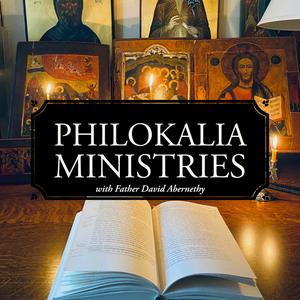
Om Philokalia Ministries
Philokalia Ministries is the fruit of 30 years spent at the feet of the Fathers of the Church. Led by Father David Abernethy, Philokalia (Philo: Love of the Kalia: Beautiful) Ministries exists to re-form hearts and minds according to the mold of the Desert Fathers through the ascetic life, the example of the early Saints, the way of stillness, prayer, and purity of heart, the practice of the Jesus Prayer, and spiritual reading. Those who are involved in Philokalia Ministries - the podcasts, videos, social media posts, spiritual direction and online groups - are exposed to writings that make up the ancient, shared spiritual heritage of East and West: The Ladder of Divine Ascent, Saint Augustine, the Philokalia, the Conferences of Saint John Cassian, the Ascetical Homilies of Saint Isaac the Syrian, and the Evergetinos. In addition to these, more recent authors and writings, which draw deeply from the well of the desert, are read and discussed: Lorenzo Scupoli, Saint Theophan the Recluse, anonymous writings from Mount Athos, the Cloud of Unknowing, Saint John of the Cross, Thomas a Kempis, and many more.
Philokalia Ministries is offered to all, free of charge. However, there are real and immediate needs associated with it. You can support Philokalia Ministries with one-time, or recurring monthly donations, which are most appreciated. Your support truly makes this ministry possible. May Almighty God, who created you and fashioned you in His own Divine Image, restore you through His grace and make of you a true icon of our Lord and Savior Jesus Christ.
Podcast-webbplatsLyssna på Philokalia Ministries, Heart Diamond – När hjärtat talar och många andra poddar från världens alla hörn med radio.se-appen
Hämta den kostnadsfria radio.se-appen
- Bokmärk stationer och podcasts
- Strömma via Wi-Fi eller Bluetooth
- Stödjer Carplay & Android Auto
- Många andra appfunktioner
Hämta den kostnadsfria radio.se-appen
- Bokmärk stationer och podcasts
- Strömma via Wi-Fi eller Bluetooth
- Stödjer Carplay & Android Auto
- Många andra appfunktioner

Philokalia Ministries
Skanna koden,
ladda ner appen,
börja lyssna.
ladda ner appen,
börja lyssna.
 Sverige