
Lyssna på den här podden kostnadsfritt i appen: Ladda ner gratis i App Store
radio.se
Sleeptimer
Spara kanal
7 avsnitt
Nature, the other climate story
2026-10-09 | 24 min.Recorded live at The Nest during Climate Week NYC 2026, this episode brings together Adam Met, co-founder of Planet Reimagined and a member of AJR, and Monica Medina, former U.S. Special Envoy for Biodiversity and Water Resources, to ask the question the climate conversation keeps stepping around: if nature is a third of the answer, why does it get treated like a footnote?
In this episode:
Why America's forests already work as a climate solution, and why their impact will rise or fall depending on what we do next
What a survey of 350,000 concertgoers taught Planet Reimagined about getting people to act, and why local wins come first
How a fan petition for tree cover at an AJR show in Phoenix fits a bigger plan for scaling local policies to the state and federal level
Why Adam says the U.S. grassroots climate movement "doesn't exist in the way we think it exists," and why concerts, comedy shows and sports games could be the way in
How the split between mitigation and adaptation pushed nature to the back burner, and why Monica calls nature a unifier
Subscribe for upcoming episodes, including our live recording at COP31.
🌱 Real talk. Real practitioners. Real solutions.How Does Good Forestry Spread?
2026-08-28 | 1 h 21 min.A forest is built by millions of separate decisions, made over timescales longer than any career, election, or fund life — while the climate moves underneath them the whole time.
That movement has done two things at once. It has made forests more valuable, because they are among the largest carbon solutions available to us. And it has made them more fragile, at a speed and reach nobody in forestry has seen before. We are leaning on forests harder than ever, at exactly the moment they are least able to take the weight.
Chris Swanston and Joseph Appiah-Gyapong have the same job on different continents: changing what other people do to trees, at scale. At the U.S. Forest Service, Chris built the translation layer — turning climate science into a decision a working forester can actually make on a particular stand. In Ghana, Joseph connected that science to the payment layer, changing what hundreds of thousands of cocoa farmers do by making the better practice the one that pays. Two halves of the same machine.
Hosts Dr. Sweta Chakraborty and Jad Daley put three questions to them: what good forest practice looks like under a changing climate, how that knowledge reaches the people who do the work, and what kind of financial support makes adoption possible.
It gets specific. Twenty percent of the southern Sierra is no longer forest — it is shrubland, and it is not coming back. Prescribed fire made giant sequoias four times likelier to survive a megafire. A forty percent stake in the harvest changes whether a farmer sets a fire. Sixty-nine percent of Ghana's carbon revenue reached communities, deliberately not as cash. And fourteen billion dollars of U.S. federal money arrived before anyone had the seedlings, the supply chain, or the workforce to spend it well.
Learn more at terraformation.com/the-understoryThe Frontline Generation (Live from London Climate Action Week)
2026-07-01 | 43 min.Everyone agrees the climate movement needs young people, and everyone agrees the next generation will live with the consequences. So why do the rooms where the decisions get made still look the way they do?
In this episode, recorded live at London Climate Action Week, hosts Dr. Sweta Chakraborty and Jad Daley dig into an uncomfortable irony — a gathering of tens of thousands convened to solve the climate crisis, where most of the people in the room are neither young nor from the communities most immediately at risk — and ask what the established movement keeps getting wrong.
They're joined by two people who responded to that gap by building institutions to close it: Samrah Khan, who helps lead a nonprofit founded on the fact that roughly 90% of climate science is published in English while about 80% of the world doesn't speak it, and Zainab Bie, who advances unconditional cash transfers as a tool for climate justice — from a pilot paying young climate defenders in Tuvalu to a proposed South Pacific Climate Justice Fund.
Guests:
Samrah Khan — Chief of Staff, Climate Cardinals; a former conservation specialist (AmeriCorps / Climate Impact Corps) who helped grow the language-justice nonprofit from a $500 Google Doc into an organization that has translated more than four million words across 100+ languages.
Zainab Bie — Asia Pacific Director, Equal Right, and co-founder of Impactship, a community of ~2,000 young changemakers across the Global South. An economist by training, she works on unconditional cash transfers and direct-access climate finance, with active projects in Tuvalu and Kenya.Why Hasn't Reforestation Scaled? Bridging Community Stewardship and Corporate Capital
2026-06-05 | 53 min.Everyone agrees reforestation needs to scale, and everyone agrees private capital has to be part of the answer. So why is it still so hard?
In this episode, hosts Dr. Sweta Chakraborty and Jad Daley dig into the gap between what corporate buyers and investors require and what the communities actually stewarding the land can offer — and what it takes to build a bridge that works for both sides.
They're joined by two people who've spent careers closing that gap from opposite ends: Hindou Oumarou Ibrahim, who represents pastoralist and Indigenous communities in Africa's Sahel, and Christine Cadigan, who built a program making U.S. carbon markets accessible to small family forest owners. The conversation gets specific — aggregation, contract length, property rights, permanence risk, and where the money actually goes (Hindou notes that less than 7% of the $1.7B pledged to Indigenous peoples at COP26 reached communities). It ends with a live agreement to pilot something together.
Hosts
Dr. Sweta Chakraborty — CEO, North America, We Don't Have Time
Jad Daley — President, Terraformation
Guests
Hindou Oumarou Ibrahim — Co-chair, International Indigenous Peoples' Forum on Climate Change; founder of the Association for Indigenous Women and Peoples of Chad. A Mbororo pastoralist, she works on participatory 3D mapping, Indigenous knowledge, and direct-access climate finance.
Christine Cadigan — EVP of Carbon Origination, American Forest Foundation; architect of the Family Forest Carbon Program and herself a family forest owner.Climate, Biodiversity, Communities — Do We Have to Choose? (Live from EarthX)
2026-05-08 | 56 min.Earth Day started in 1970 with twenty million Americans, a bipartisan coalition, and no carbon agenda. It gave us the EPA, the Clean Water Act, the Endangered Species Act. So why does it feel like the environmental movement has spent the last two decades narrowing — not expanding?
Recorded live at EarthX in Dallas on Earth Day 2026, this episode brings together some of the most credible voices in American conservation to ask the question most people in this space won't say out loud: has the obsession with carbon as the single metric for nature been holding us back?
In this episode:
Why the shift from "nature" to "climate" wasn't inevitable — and who benefited from it
How siloed funding structures are actively limiting what gets built on the ground
The Trinity River Audubon Center: what 120 acres on a former illegal landfill tells us about what restoration can look like
Why the bipartisan conservation coalition fractured — and whether it can be rebuilt
What investors and business leaders actually need to change about how they spend money on this
Subscribe for upcoming episodes, including live ones at COP, Climate Week, and beyond.
🌱 Real talk. Real practitioners. Real solutions.
Fler podcasts i Natur

Trendiga poddar i Natur

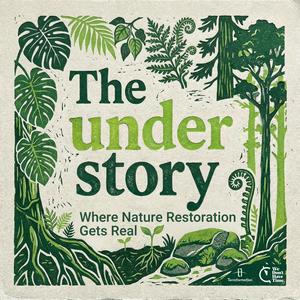
Om The Understory - a podcast where nature restoration gets real
The case for restoring the world's forests and ecosystems has been made — repeatedly. The Understory is for everyone ready to ask what comes next: the practitioners, scientists, and builders working on the harder questions the main stages don't have room for.
Every episode starts from a shared premise: the science, the economics, and the moral case for restoration have been made — repeatedly. The Understory is not interested in making that case again. It starts from where that conversation ends, and asks why restoration hasn't scaled, who's been blocking it, and what's actually working.
Podcast-webbplatsLyssna på The Understory - a podcast where nature restoration gets real, The BirdGuides Podcast och många andra poddar från världens alla hörn med radio.se-appen
Hämta den kostnadsfria radio.se-appen
- Bokmärk stationer och podcasts
- Strömma via Wi-Fi eller Bluetooth
- Stödjer Carplay & Android Auto
- Många andra appfunktioner
Hämta den kostnadsfria radio.se-appen
- Bokmärk stationer och podcasts
- Strömma via Wi-Fi eller Bluetooth
- Stödjer Carplay & Android Auto
- Många andra appfunktioner

The Understory - a podcast where nature restoration gets real
Skanna koden,
ladda ner appen,
börja lyssna.
ladda ner appen,
börja lyssna.
 Sverige

