PoddsändningarKurserFramework: The Center for Internet Security (CIS) Top 18 Controls

Framework: The Center for Internet Security (CIS) Top 18 Controls

Jason Edwards
Framework: The Center for Internet Security (CIS) Top 18 Controls
Senaste avsnittet

83 avsnitt

  • Framework: The Center for Internet Security (CIS) Top 18 Controls

    Welcome to the CIS 18 Control Framework

    2025-10-18 | 1 min.
  • Framework: The Center for Internet Security (CIS) Top 18 Controls

    Episode 82 — Safeguard 18.2 – Internal and red team exercises

    2025-10-18 | 12 min.
    Safeguard 18.2 extends penetration testing to include internal assessments and red team exercises that emulate an attacker with initial access. Internal testing evaluates how far a threat could move laterally, escalate privileges, and access sensitive data once inside the network. Red team exercises simulate full-scale adversary campaigns, testing detection, containment, and response capabilities across technical and human layers. These exercises reveal not just vulnerabilities, but also gaps in processes and situational awareness. They measure whether monitoring tools trigger alerts, whether analysts interpret them correctly, and how quickly response teams can contain the intrusion. Internal and red team testing transforms theoretical preparedness into proven readiness, helping organizations close the final mile between defense design and real-world resilience.
    Implementing this safeguard involves careful planning and coordination between leadership, blue teams, and testing personnel. Internal tests should include domain privilege escalation, network traversal, and data exfiltration attempts, all performed under controlled conditions with predefined safety boundaries. Red team engagements require clearly documented objectives, such as testing detection of phishing payloads or lateral movement techniques. During these exercises, communication protocols and deconfliction measures prevent accidental business disruption. Post-engagement debriefs bring together both offensive and defensive participants to review findings collaboratively, focusing on lessons learned rather than blame. Metrics such as detection time, escalation efficiency, and remediation completion rates guide continuous improvement. When performed regularly, internal and red team exercises evolve cybersecurity from static prevention toward adaptive readiness—where the organization learns directly from simulated adversaries and strengthens every layer of its defense and response capability.
     Produced by BareMetalCyber.com, where you’ll find more cyber audio courses, books, and information to strengthen your educational path. Also, if you want to stay up to date with the latest news, visit DailyCyber.News for a newsletter you can use, and a daily podcast you can commute with.
  • Framework: The Center for Internet Security (CIS) Top 18 Controls

    Episode 81 — Safeguard 18.1 – External testing programs

    2025-10-18 | 10 min.
    Safeguard 18.1 requires organizations to establish and maintain a formal penetration testing program that includes recurring external assessments. External tests simulate real-world attackers operating from outside the enterprise perimeter, probing exposed systems, web applications, and cloud environments for exploitable weaknesses. Unlike automated vulnerability scans, these engagements apply human expertise to chain vulnerabilities, test business logic, and evaluate how well network defenses withstand targeted attacks. The program must define scope, frequency, and reporting standards, ensuring that results are actionable and repeatable. External penetration testing provides the most realistic measurement of how resilient an organization’s public-facing assets truly are and whether the layered defenses described in previous controls—such as patching, configuration management, and monitoring—perform effectively under adversarial pressure.
    To operationalize this safeguard, enterprises should define a documented testing policy outlining which assets, IP ranges, and applications fall within scope. Engagements must be performed by qualified testers who follow strict rules of engagement to avoid service disruption while still providing comprehensive evaluation. Pre-test coordination with internal teams ensures monitoring and incident response systems are aware of expected activity, allowing evaluation of detection effectiveness. After testing, findings should be risk-ranked, correlated with asset criticality, and assigned to responsible owners for remediation. Reports must include technical evidence, proof-of-concept details, and mitigation recommendations. Testing frequency should be at least annual, or more often after significant infrastructure or application changes. Over time, an external testing program evolves from compliance validation into a continuous improvement process—one that strengthens trust by demonstrating that defenses are not only designed well but tested against real threats in authentic conditions.
     Produced by BareMetalCyber.com, where you’ll find more cyber audio courses, books, and information to strengthen your educational path. Also, if you want to stay up to date with the latest news, visit DailyCyber.News for a newsletter you can use, and a daily podcast you can commute with.
  • Framework: The Center for Internet Security (CIS) Top 18 Controls

    Episode 80 — Overview – Why penetration testing validates defenses

    2025-10-18 | 10 min.
    Control 18—Penetration Testing—closes the CIS framework by validating how well all other controls perform under real-world conditions. While vulnerability scanning identifies potential weaknesses, penetration testing goes further by exploiting them to assess the enterprise’s true exposure. These controlled attacks, conducted by skilled professionals, reveal how vulnerabilities chain together, how far an attacker could advance, and whether detection and response mechanisms activate as intended. Penetration testing provides management with concrete evidence of risk, translating technical gaps into business impact. It verifies that security investments deliver measurable protection and highlights areas where layered defenses may overlap or fail. Ultimately, this control ensures that an organization’s cybersecurity posture is not theoretical but proven through realistic adversarial testing.
    Conducting effective penetration tests requires clear scope, defined rules of engagement, and strong collaboration between testers and stakeholders. Scenarios should reflect both external and internal attack perspectives, covering network, application, and physical entry points. Tests may also include social engineering components to gauge user resilience. All testing must balance realism with safety—avoiding disruption while capturing authentic results. Findings should be prioritized by exploitability and potential business impact, with remediation plans tracked through formal governance channels. Repeat testing validates that fixes are effective and that no regressions occur over time. For mature organizations, red team exercises simulate advanced, persistent threats to evaluate end-to-end detection and response capabilities. Control 18 thus serves as the final proof point of the CIS Controls: confirming that security architecture, processes, and people can withstand—and learn from—the tactics of real adversaries.
     Produced by BareMetalCyber.com, where you’ll find more cyber audio courses, books, and information to strengthen your educational path. Also, if you want to stay up to date with the latest news, visit DailyCyber.News for a newsletter you can use, and a daily podcast you can commute with.
  • Framework: The Center for Internet Security (CIS) Top 18 Controls

    Episode 79 — Remaining safeguards summary (Control 17)

    2025-10-18 | 9 min.
    The remaining safeguards in Control 17 reinforce the full lifecycle of incident response—spanning preparation, communication, testing, and continuous improvement. These include assigning key response roles, defining secure communication mechanisms, conducting post-incident reviews, and establishing thresholds that differentiate normal events from true incidents. Together, these steps ensure that teams can act quickly, share accurate information, and recover efficiently without confusion. Designated roles provide clarity of authority; communication protocols—both primary and backup—keep coordination intact even if normal channels are compromised. Post-incident reviews transform each response into a learning opportunity, refining both technology and human processes. Defining thresholds prevents overreaction to minor anomalies while ensuring serious incidents receive immediate escalation.
    Implementing these safeguards requires integrating technical and organizational readiness. Communication tools—such as dedicated incident bridges, encrypted messaging, and offline contact lists—must be tested alongside technical playbooks. Regular cross-functional meetings evaluate whether response thresholds and classification criteria still match business risk and compliance obligations. Documentation from post-incident reviews should update training materials, configuration baselines, and preventive controls. Mature organizations track and trend incident metrics to identify recurring weaknesses and measure improvement over time. When practiced consistently, these safeguards build resilience not just in systems, but in people and processes. Control 17, as a whole, evolves cybersecurity from a set of defensive measures into a dynamic capability—one that anticipates disruption, coordinates under pressure, and emerges stronger from every challenge encountered.
     Produced by BareMetalCyber.com, where you’ll find more cyber audio courses, books, and information to strengthen your educational path. Also, if you want to stay up to date with the latest news, visit DailyCyber.News for a newsletter you can use, and a daily podcast you can commute with.

Fler podcasts i Kurser

Om Framework: The Center for Internet Security (CIS) Top 18 Controls

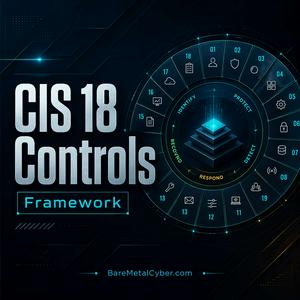
The **CIS Critical Security Controls Audio Course** is a comprehensive, audio-first training series that guides listeners through all eighteen **CIS Controls**, transforming one of the world’s most respected cybersecurity frameworks into clear, actionable learning. Designed for professionals, students, and auditors alike, this series explains each control in practical, plain language—focusing on how to implement, assess, and sustain them in real environments. With eighty-three structured episodes, the course walks you step by step through the safeguards that define effective cybersecurity, helping you understand not only what to do but why each measure matters. The **CIS Controls**, maintained by the Center for Internet Security, represent a globally recognized set of prioritized actions proven to reduce the most common and dangerous cyber risks. Organized across eighteen control families—from inventory and configuration management to incident response and data recovery—the framework provides a practical roadmap for building defensible, risk-aligned security programs. This course explores how organizations can adopt the controls incrementally, measure maturity over time, and map them to other standards such as NIST, ISO 27001, and PCI DSS for comprehensive alignment. Developed by **BareMetalCyber.com**, the CIS Critical Security Controls Audio Course delivers structured, exam-aligned instruction that bridges policy and practice. Each episode reinforces understanding through real-world context, helping listeners translate framework requirements into measurable actions that strengthen organizational resilience and long-term security maturity.
Podcast-webbplats

Lyssna på Framework: The Center for Internet Security (CIS) Top 18 Controls, LSE: Public lectures and events och många andra poddar från världens alla hörn med radio.se-appen

Hämta den kostnadsfria radio.se-appen

  • Bokmärk stationer och podcasts
  • Strömma via Wi-Fi eller Bluetooth
  • Stödjer Carplay & Android Auto
  • Många andra appfunktioner

Framework: The Center for Internet Security (CIS) Top 18 Controls: Poddsändningar i Familj

  • Podcast Certified - Azure Cloud Fundamentals (AZ-900)
    Certified - Azure Cloud Fundamentals (AZ-900)
    Kurser, Teknologi, Utbildning
Sociala nätverk
v8.8.13| © 2007-2026 radio.de GmbH
Generated: 4/30/2026 - 6:04:35 AM